
Why seasons, not traits, the real foundation of astrology
Zodiac signs are seasons, not personality labels. A trait list hands you an adjective and stops. A seasonal read gives you the reason a description holds, which means you can ask when that logic helps you and when it costs you. One is something you are. The other is something you can work with.
If you have ever rolled your eyes at astrology, I would bet you were reacting to a trait list. Aries is impulsive. Virgos are perfectionists. Scorpios are intense. Said like that, with no explanation attached, it is just a label, and labels without reasons are exactly what makes this whole field sound made up.
Here is the distinction I actually work from, and it is why my approach reads differently than most astrology content you will find. The zodiac is the primary system. It is a symbolic language, built up over a very long time, for describing how different phases of the sun’s yearly cycle tend to feel and function.
A trait list hands you the label and stops. Seasonal astrology asks the next question: why would this particular phase of the year produce this particular pattern, and does that reasoning actually hold up.
The zodiac’s claim, and the evidence for it
Read that again, because the order matters. The zodiac makes a claim first, something like “Aries moves fast and starts things.” Then I go looking for the seasonal evidence that explains why that claim tracks.
Early spring is a real, observable moment in the year. First growth pushing up before conditions have fully proven themselves, everything still cold at the edges but committed to going anyway.
That is not me saying the cold made an Aries impulsive. It is me showing you why “moves fast and starts things” is a coherent way to describe the logic of that exact stretch of the year, and why generations of people watching that same stretch happen over and over again would land on language like this to describe it.
I want to be precise about what I am not claiming, because it is easy to slide into overclaiming here and I would rather not. I am not saying the season programmed your nervous system. I am not saying the temperature you were born into determined your personality the way biology determines eye colour.
The honest position is that the causal question, why does a birth season correlate with anything at all, stays open. What I can tell you is that the seasonal parallel is a genuinely useful lens for understanding why a sign’s description makes sense, and that is a different and much more modest claim than “the weather made you this way.”
Why a label without a reason does not hold up
A trait list fails in a specific way. It describes behaviour without explaining it, which means it cannot tell you anything about context, timing, or why the same person might read differently depending on what is actually happening around them.
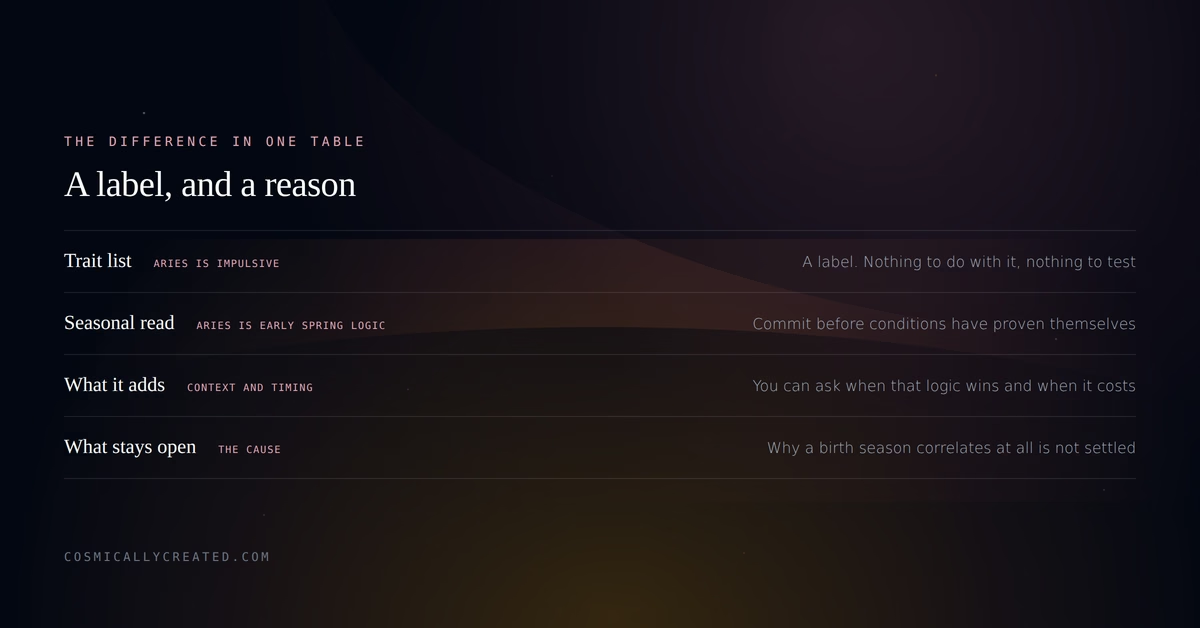
“Aries is impulsive” does not tell you when that impulsiveness helps and when it costs you. “Aries is early spring’s commit before you are certain logic” does, because now you have a mechanism you can actually reason about. You can ask when that logic is the right strategy and when it is not, which a static label never lets you do.
That is the real difference between the two approaches. One hands you an adjective. The other hands you a reason, and a reason is something you can actually use.
There is a second failure that follows from the first. A trait list has no way to explain contradiction. If Aries is impulsive, what do you do with the Aries who has spent fifteen years learning to sit on a decision for a day before acting on it? The label says they stopped being an Aries. The seasonal read says they learned to run the same logic with a delay in it, which is a completely different and far more useful account of what happened.
And a third. A trait list cannot tell you what a sign is for. It can tell you that Capricorns are disciplined, but not why anybody would need to be, or in what conditions that discipline is the correct move rather than a personality quirk. Once you know that the discipline maps onto the month that gives you nothing back, the whole thing stops being a character description and starts being a strategy with a use case.
What each stretch of the year is actually solving
The wheel works this way in a very literal sense. The wheel is the solar year cut into twelve, and each cut has a different problem in front of it. Once you see the four quarters, the twelve stop looking like a list of personality types and start looking like a sequence.
Spring, the breaking through quarter
Aries, Taurus, Gemini. The ground is still resistant and something has to go first anyway. Then whatever went first has to root, or it blows away. Then, once everything is up at once and the whole landscape is communicating, somebody has to be able to track six things simultaneously without losing any of them.
Summer, the full expression quarter
Cancer, Leo, Virgo. The year is open. The problem shifts from getting here to holding what has arrived. Gather it in and make it safe. Show it, at full size, without apology. Then, as the light starts to tip, sort what is actually ready from what only looked ready.
Autumn, the release quarter
Libra, Scorpio, Sagittarius. Light and dark reach parity and then the dark starts winning. Weigh what stays against what goes. Take apart what is finished, thoroughly, so it feeds the next round. Then, with the ground bare, go looking for the reason any of it was worth doing.
Winter, the structure quarter
Capricorn, Aquarius, Pisces. Nothing is growing and nothing will for weeks. Build and hold the structure that gets you through it. Stand far enough back to see the shape of the whole system, since there is no foliage in the way. Then let the edges dissolve, because the thaw does not arrive as a decision, it arrives as everything going soft at once.
Four problems, twelve answers. Every trait you have ever seen on a list is one of those answers, described from outside by somebody who did not know what question it was answering.
Three signs, read both ways
The fastest way to feel the difference is to put the two readings next to each other on signs people already have strong opinions about.
Aries
Trait list: impulsive, aggressive, selfish. Seasonal read: the logic of the moment when nothing has been proven and somebody has to move anyway. That logic is correct in a startup, in an emergency, in any situation where the cost of waiting exceeds the cost of being wrong. It is expensive in a situation that rewards patience. Now you have something to work with.
Virgo
Trait list: critical, picky, perfectionist. Seasonal read: the logic of the turn from summer into autumn, when the difference between ready and nearly ready has consequences and hoping will not fix it. That logic is what you want in anything with a real standard attached. It turns on its owner when there is no external deadline and the sorting has nothing left to sort but themselves.
Scorpio
Trait list: manipulative, secretive, intense. Seasonal read: the logic of the month that breaks things down, which requires the thing to be genuinely finished and requires somebody willing to be present for the ugly middle of it. That is why they are the ones you want in a crisis and the ones nobody wants at a light dinner party.
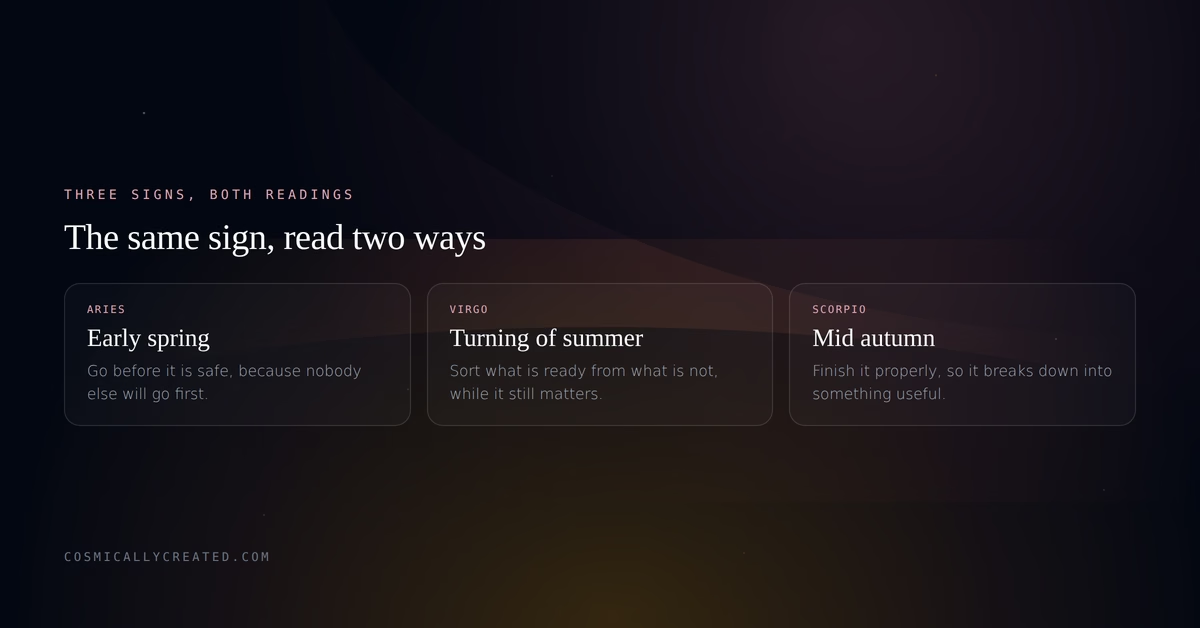
Notice what happened in each of those. The behaviour did not get denied and it did not get flattered. It got explained, and then it got a set of conditions attached, and the conditions are where all the actual usefulness lives.
Where the causal question actually stands
I said above that I am not claiming the season produced the person. I want to spend a minute on that, because it is the part most seasonal astrology content skips, and skipping it is how a good idea turns into a bad one.
There is real research on birth month and various outcomes, and it is genuinely messy. Some findings replicate, many do not, and the ones that do have candidate explanations that have nothing to do with the sky, including school cut off dates, seasonal illness exposure, and how much daylight a newborn gets in their first months. Any honest person looking at that literature says the same thing: something might be there, the size is small, and the mechanism is not established.
So I do not build on the mechanism. I build on the description. The claim I am making is narrower and, I think, much more defensible: the seasonal parallel explains why the zodiac’s language is coherent rather than arbitrary. It tells you why “Aries starts things” and “Capricorn endures” are not interchangeable, why the twelve descriptions do not collapse into each other, and why a system this old kept its shape.
That is evidence for the language. It is not a demonstration of a cause, and I am not going to dress it up as one to make a page more convincing.
What this changes about reading your own chart
Once you are working from the seasonal logic instead of a trait list, you stop treating your placements as a fixed identity and start treating them as a strategy that made sense in a specific context.
That is not a small shift. A trait is something you either are or are not. A strategy is something you can recognise, question, and choose to apply on purpose instead of running on autopilot.
This does not remove your agency, it restores context to it. Knowing that a pattern has a logic behind it does not mean you are stuck repeating it. It means you finally know what you are working with.
It also changes what you do with the rest of the chart. If your sun is a strategy rather than a label, then so is your rising, and so is your moon, and the reason two people with the same sun read nothing alike stops being a mystery. They are running the same core logic through completely different front ends. The sun is what you are practising. The rising is what the room meets. The moon is what you reach for when it has gone wrong.
If you want the full breakdown of how this works across all twelve signs, from what is actually happening in the sky and on the ground during each stretch of the year to why that maps onto the personality language astrology uses for it, I lay the whole thing out in zodiac seasons explained. That is the pillar page for this whole approach, and it is the place to start if this is your first time here.
Where this leaves you
Astrology is not magic and it is not a costume you put on. It is a very old, very consistent way of tracking when you entered the year’s cycle and what that timing tends to mean.
Trait lists give you the shorthand. Understanding the season behind the sign gives you the actual reasoning, and once you have that, the whole system stops feeling like guesswork and starts feeling like something you can genuinely think with.
That is the entire argument for reading the wheel this way rather than as a set of fixed traits. Not because the seasonal version is prettier, but because it is the only version that survives being asked why.
A trait list hands you an adjective. A seasonal read hands you a reason, and a reason is something you can argue with.
Questions about the seasonal foundation
What does it mean to say zodiac signs are seasons?
It means each sign maps onto a specific phase of the sun’s yearly cycle, and that phase has its own conditions and its own problem to solve. The sign’s description is language for that phase, not a fixed label attached to a person.
Does the season you are born in cause your personality?
I would not claim that. The causal question stays open on purpose. The seasonal parallel explains why the zodiac’s descriptions are coherent rather than arbitrary, which is evidence for the language, not a demonstration of a mechanism.
What is wrong with a normal trait list?
It gives you behaviour with no explanation, so it cannot tell you about context or timing, and it has no way to account for a person who has clearly grown. A reason lets you ask when a pattern helps and when it costs you. An adjective never does.
Does this work in the southern hemisphere?
The dates are set by the sun’s position, not by local weather, so the sign boundaries do not flip. What does change is your lived experience of the season, which is worth reading alongside the sign rather than instead of it.
How is this different from regular astrology?
It is not a different zodiac. It is the same twelve signs with the reasoning left in. Most content gives you the conclusion. This gives you the argument that produced the conclusion, so you can check whether it holds.
Where should I start if I am new to this?
Read your sun sign’s season first, then your rising, then your moon. The Season Map is the free version of that and needs no birth time. Zodiac seasons explained is the long form walk through all twelve.
Why do the sign dates move by a day some years?
Because the equinoxes and solstices drift against the calendar, and the sign boundaries follow the sun rather than the date. If your birthday sits on a cusp, pull the chart for your actual birth year.
Can I still use this if I do not believe in astrology?
Yes, and plenty of people do. Treated as a vocabulary for twelve recurring strategies, it is useful whether or not anything in the sky is doing anything. That is roughly where I sit on it myself.
Season boundaries move by a day some years, because the equinoxes and solstices drift against the calendar. If your birthday sits near a boundary, pull the chart for your birth year rather than trusting a date range.
See it in your own chart
Your sun is one of twelve stretches of the year, and only one line of a chart with dozens. The Season Map is free, six pages, and needs no birth time. It shows which weeks of your own year are loaded and which are quiet.
If you want the full read written for your chart, that is The Seasonal Blueprint.
Keep reading
Want your own year mapped out like this?
A Season Map is six pages built from your birth chart. It lays your year out as a calendar: the weeks that are loaded, the months that hold nothing at all, with real dates. It costs nothing and I write them by hand.
You are on the list.
Your Season Map is being written by hand, so give it a few days. It lands from Jakayla at cosmicallycreated.com, so keep an eye out for that name.