
Where astrology came from
Ask where astrology came from and you will usually get one of two answers. Either it is ancient wisdom passed down from people who knew things we have forgotten, or it is a farming calendar that got mistaken for a personality test. Neither one is right, and the second one is the one I want to take apart, because it is the answer I hear most often from people who think they are being the sensible one in the room.
The short version of where astrology came from, and the whole argument of this page: humans watched what the earth does as the sun moves through the year, for a very long time, and eventually built language for how the different phases of that cycle shape being alive inside them. The observation is climate and light. The system is what got built on top of it.
Where astrology came from, the answer you usually get
The farming calendar version goes like this. Ancient people needed to know when to plant and when to prepare for winter, so they watched the sky, and the zodiac is what is left of that scheduling system. Somewhere along the way people got confused and started using it for personality.
As an account of where astrology came from it sounds reasonable. It is also doing something sneaky, which is why it is worth naming. It explains the calendar and then treats the meanings as an error, a later corruption of a practical tool by people who did not understand what they had.
That is not what happened, and you can tell because of what the earliest surviving texts on the origin of the zodiac actually contain.
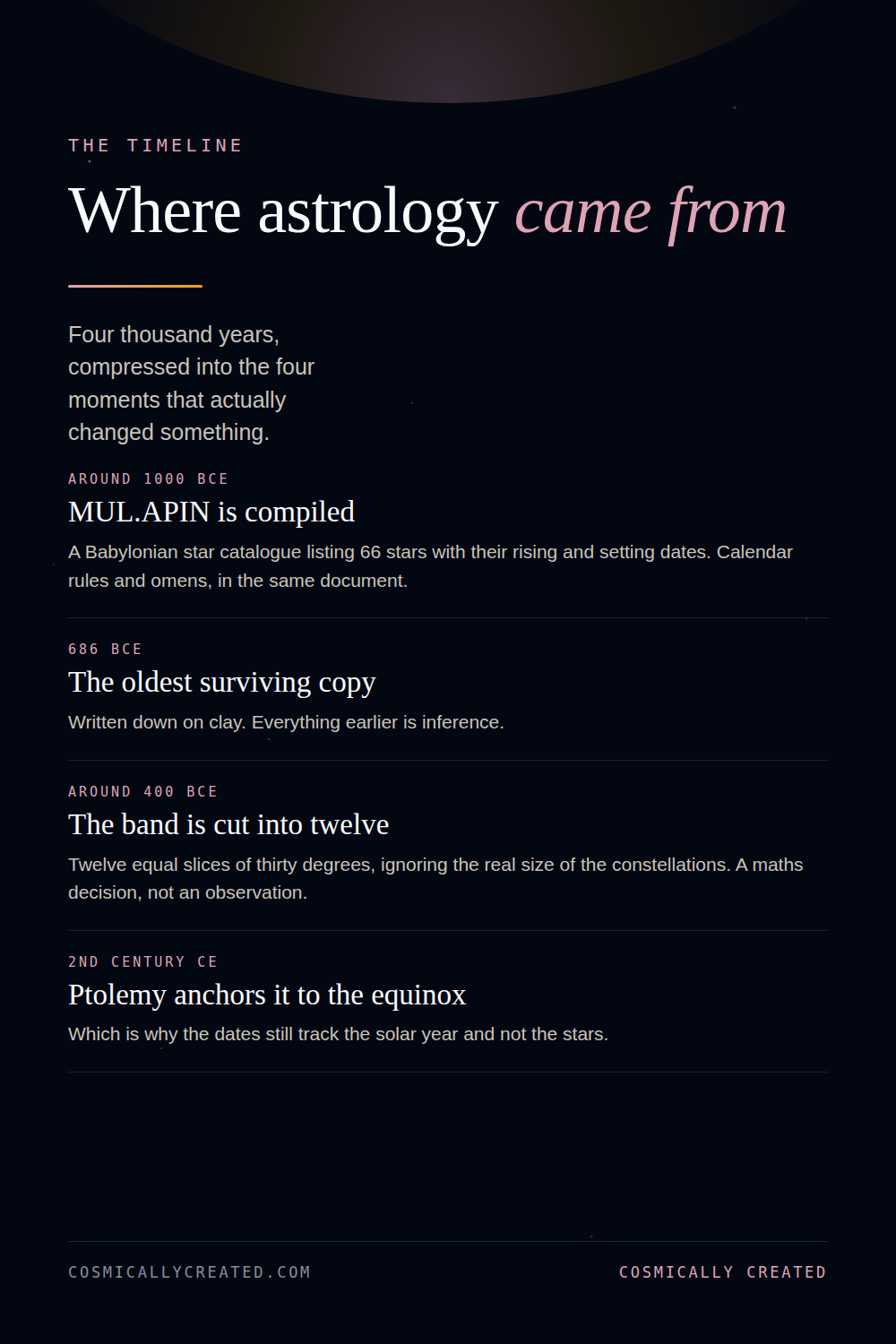
The Babylonian compendium known as MUL.APIN was likely compiled around 1000 BCE, and the oldest copy we have was written in 686 BCE. It lists sixty six stars and constellations with their rising, setting and culmination dates. It contains calendar rules and intercalation rules, the maths for keeping a lunar calendar in step with the solar year. And it also contains omens. Both things, in the same document, from the beginning.
The scheduling and the meaning were never separate systems that got confused with each other. They came from the same act of paying attention.
What people were actually tracking
Here is the part the farming story gets backwards, and it is the hinge of where astrology came from. Nobody was watching crops. Crops are the downstream effect. What was being tracked was the sun, and specifically where along the horizon it rises, how high it climbs, and how long it stays up.
That is the only genuinely reliable thing in the sky from the ground. Weather is local and erratic. Rainfall varies. Temperature lags and swings. But the sun’s position over the year is exact, repeatable, and identical every single cycle. It is the one measurement that does not lie to you.
And you do not need an instrument to take it. Put a stick in the ground and mark the tip of its shadow at noon each day for a year. The mark moves, then stops, then comes back. You have just measured the solar year with a stick.
Everything downstream of that, the temperature, the light, the abundance and the scarcity, follows the same cycle with a lag. So the sun’s position is not a proxy for the growing conditions. It is the thing the growing conditions are a proxy for.
The four points anyone can find without instruments
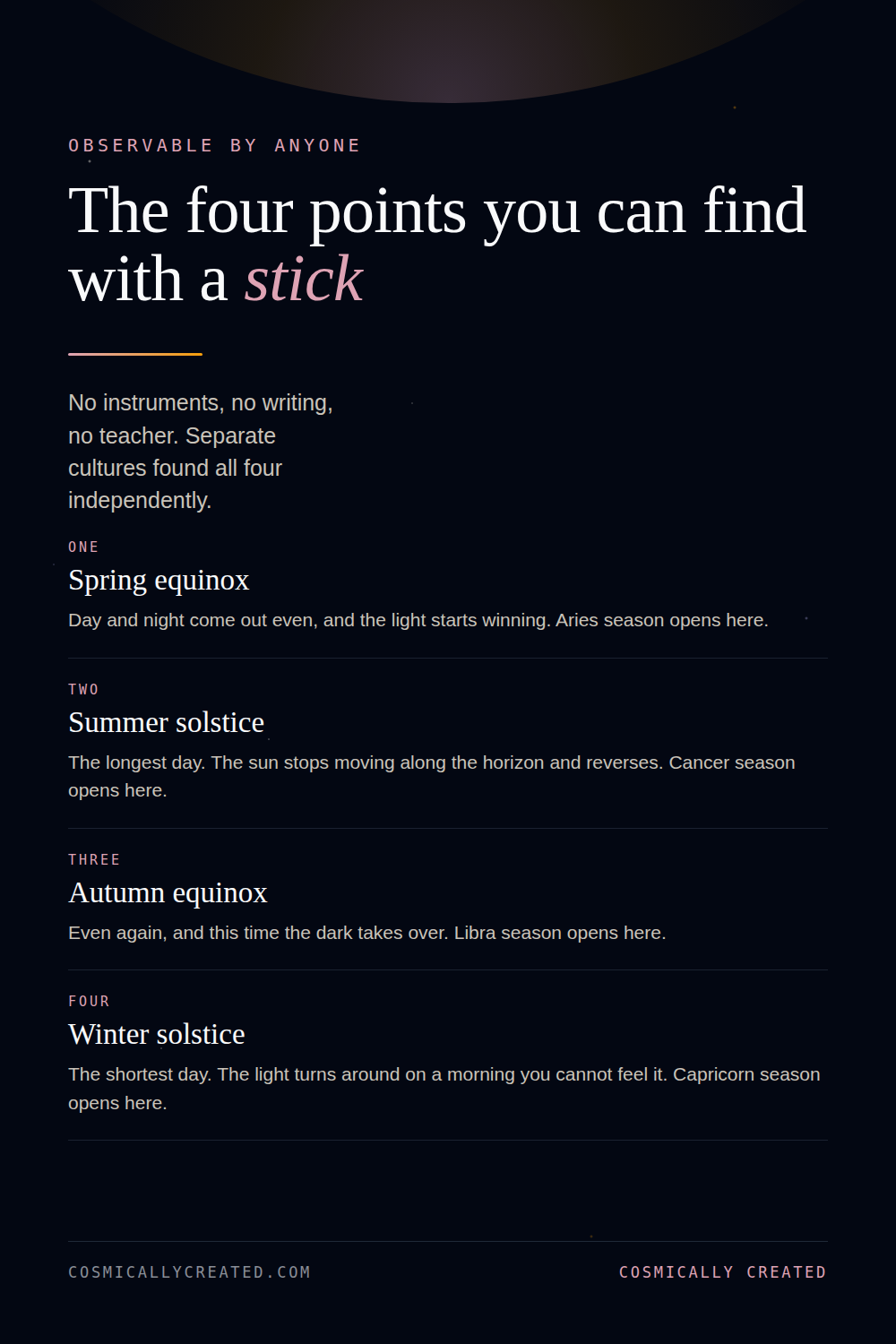
Any honest account of where astrology came from starts here. Four moments in the year announce themselves clearly enough that separate cultures with no contact found all four independently.
Two solstices, when the sun stops moving along the horizon and reverses. Two equinoxes, when day and night come out even. You can find all four with the stick. You do not need writing, maths, or anybody to teach you.
Those four points cut the year into quarters, and every seasonal system anybody has ever built starts there, which is why where astrology came from is the same story in a dozen unconnected cultures. What differs between cultures is how the quarters get subdivided and what gets said about them. What does not differ is the four corners, because the four corners are not a cultural choice. They are just where the sun is.
Where astrology came from, in four cards
The whole argument on this page, condensed. Save or pin whichever is useful.
How the sky became twelve
MUL.APIN describes a set of constellations sitting along the path the moon takes across the sky. That band is the ecliptic, roughly the plane the whole solar system sits in, which is why the sun, the moon and the planets all appear to travel through the same narrow strip.
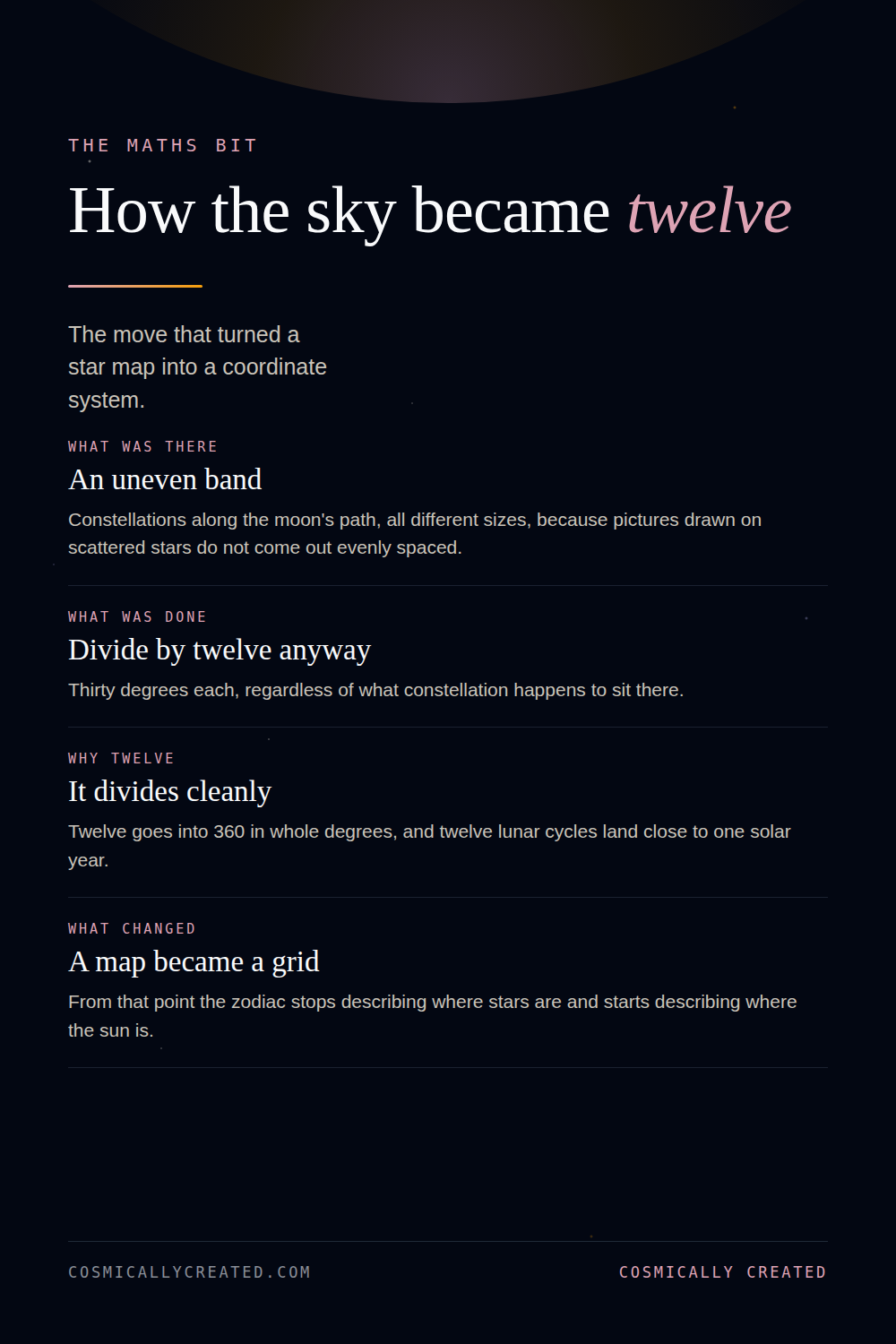
The early lists were not tidy. The constellations along that band are different sizes, because constellations are pictures people drew on an uneven scatter of stars, and pictures do not come out evenly spaced.
The move that produced the zodiac we use was throwing that unevenness away. Somewhere around the fifth century BCE, by most accounts, the band got divided into twelve equal slices of thirty degrees each, regardless of how big the constellation sitting there happened to be.
That is a mathematical decision, not an observational one, and it is the moment the zodiac stops being a star map and becomes a coordinate system. Twelve because it divides the circle cleanly, and because twelve lunar cycles land close enough to one solar year to be useful.
The last major turn in where astrology came from is Greek. They inherited the Babylonian system, ran it through their own philosophy, and Ptolemy anchored it to the equinox rather than to the stars in the second century CE. That anchoring is why the tropical zodiac used across most of the West still starts at the spring equinox, and it is why the sign dates track the solar year rather than the constellations, which have since drifted.
Where astrology came from is not the same as where the meanings came from
This is the layer everybody skips in the story of where astrology came from, and it is the only interesting part.
Dividing the year into twelve gives you a coordinate system. It does not give you a single word about what any of it means. So where did the meanings come from?
Not from revelation and not from the stars themselves, which is the part of where astrology came from that gets left out. From generations of people living inside the same twelve conditions, every year, and noticing what worked in each one. Late winter asks something different of a person than peak summer does. Everybody who has lived through both knows this in their body. What the zodiac did was hold still long enough to write it down.
The descriptions are compressed observation. Thousands of years of people noticing what a particular stretch of the year does to a group and what strategies get you through it, boiled down into a symbol and a paragraph. That is a lossy format and a lot got mangled on the way. It is also the oldest continuously maintained record of how the year feels from the inside that anybody has.
Which is why the seasonal reading is not a modern reinterpretation of an old farming tool. It is closer to the original than the personality quiz version is.
The three layers, and why the order matters
Most arguments about the history of astrology happen because people are talking about three different things and calling all of them astrology.
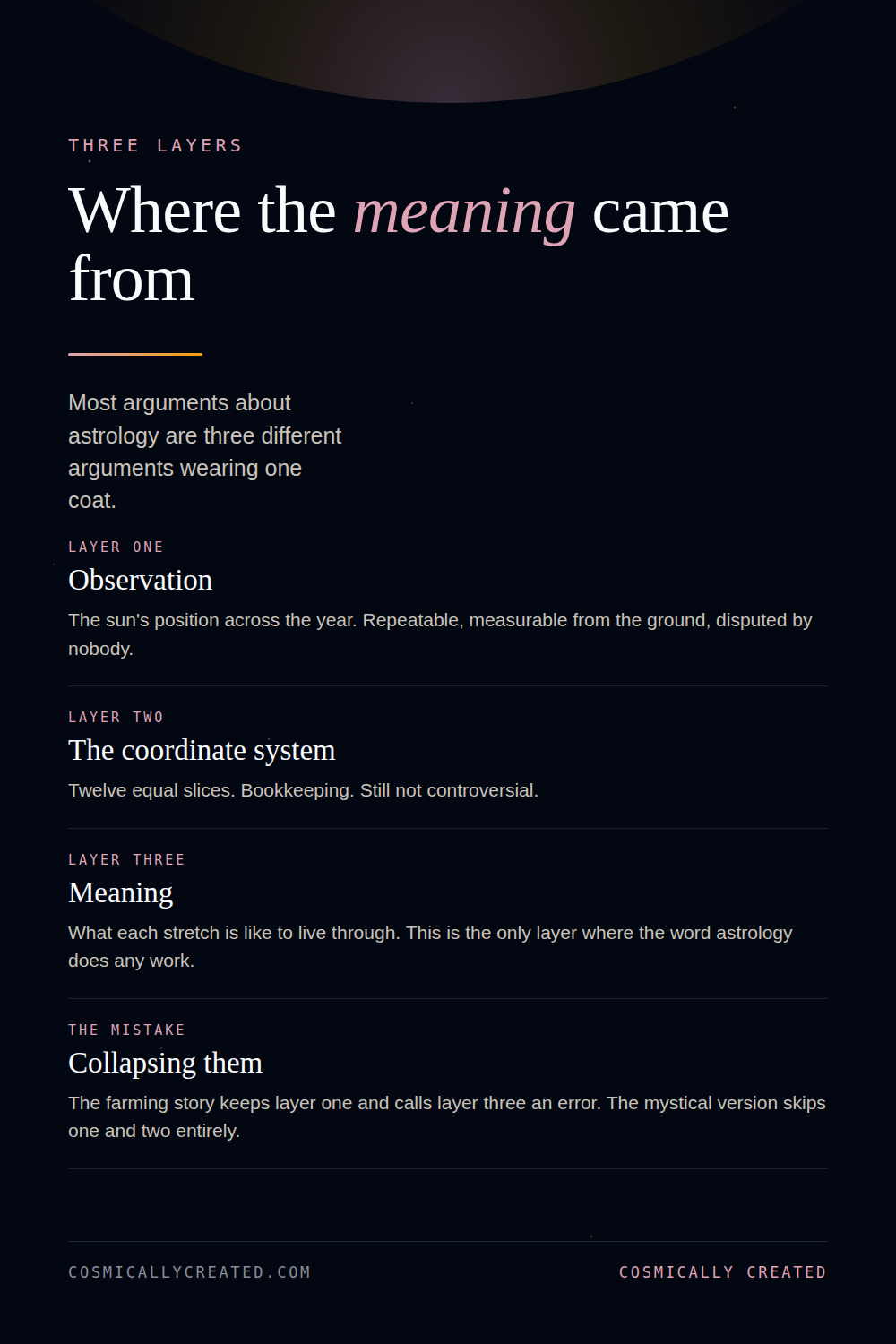
The first layer is observation. The sun’s position across the year, measured from the ground, repeatable, and not in dispute by anybody. That layer is astronomy and it is where where astrology came from genuinely starts.
The second layer is the coordinate system. Twelve equal slices laid over an uneven band of constellations, a decision made for mathematical convenience. Still not controversial, still just bookkeeping.
The third layer is meaning. What each of those twelve stretches is like to live through, and what gets a person or a group through it. This is the layer people fight about, and it is the only layer where the word astrology starts doing any real work.
The farming calendar story collapses all three into the first one and then declares the third a mistake. The mystical version skips the first two entirely and treats the third as revelation. Both are avoiding the interesting question, which is what happens when you take thousands of years of compressed observation seriously as observation without pretending it is physics.
Getting the history of astrology right matters mostly because it tells you which layer you are standing on when you make a claim.
Why any of this still matters
Because the two wrong answers about where astrology came from produce two wrong ways of using it.
If astrology is ancient mystical wisdom, then it is a source of truth and you are supposed to obey it. That produces fatalism and it produces people making decisions they can already tell are bad because Mercury told them to.
If astrology is a garbled farming calendar, then it is meaningless and the only respectable move is to laugh at it. That throws away a genuinely enormous body of compressed observation because the packaging is embarrassing.
The third option is that it is a description of a cycle, built by observation, maintained badly, and still useful if you read it as a description rather than an instruction. That is the version I write from.
What I am not claiming
I am not claiming the seasons cause anything about a person. The zodiac is the system here, and what the earth does across the year is the evidence for why the system’s description of each phase makes sense. Not the mechanism.
I am not claiming astrology is secretly ecology, or that this is a scientific explanation dressed up. Why any of it correlates with anything, or whether it does, is a question I hold open rather than one I have quietly answered.
I am not claiming a placement decides anything. A placement describes a tendency. What a person does with a tendency is still theirs.
And I am not claiming this is the complete history. The Babylonian thread is the one with the best surviving documentation, but Egyptian, Greek, Indian and Chinese systems all developed their own versions, some of them independently, and the full story is a great deal messier than any single origin post can honestly cover.
Common questions about where astrology came from
Who invented astrology, and does where astrology came from have one answer?
Nobody, in the sense of a single person or moment. The observational core goes back further than writing does. The Babylonians produced the earliest surviving systematic version, the Greeks reworked it philosophically, and it has been continuously modified ever since.
How old is the zodiac, and how far back does where astrology came from go?
The constellations along the moon’s path are catalogued in a text likely compiled around 1000 BCE, with the oldest surviving copy dated 686 BCE. The twelve equal thirty degree divisions we actually use came later, most likely around the fifth century BCE.
Was the zodiac originally a calendar?
It was used for calendar keeping, along with several other things, in the same documents that also record omens. Calling it originally a calendar implies the meanings arrived later as a mistake, and the earliest texts do not support that.
Why are there twelve signs and not ten or twenty?
Twelve divides a circle cleanly into whole degrees, and twelve lunar cycles come close to one solar year. The division is a mathematical convenience laid over an uneven set of constellations, not a count of anything in the sky.
Why do the zodiac dates not match the constellations anymore?
Because the tropical zodiac used across most of the West is anchored to the spring equinox rather than to the stars, a choice made explicit by Ptolemy. The earth wobbles slowly on its axis, so the stars have drifted against that anchor by roughly a full sign since. The sidereal zodiac used in Indian astrology stays anchored to the stars instead, which is why the two disagree.
Does knowing where astrology came from change how you use it?
Knowing where astrology came from changes what kind of thing you think you are holding. A description of a repeating cycle gets used differently from a prophecy, and most of the bad advice in this field comes from treating the first as the second.
The version of this that is about your chart
Everything above is the system. Your chart is the specific case: which stretch of the year your sun, moon and rising are each built out of, and what strategy each of those phases runs on.
The Seasonal Blueprint Mini covers those three for $29. If you would rather read a full one before spending anything, the Resource Vault is free and has complete sample readings in it.
Keep reading
Want your own year mapped out like this?
A Season Map is six pages built from your birth chart. It lays your year out as a calendar: the weeks that are loaded, the months that hold nothing at all, with real dates. It costs nothing and I write them by hand.
You are on the list.
Your Season Map is being written by hand, so give it a few days. It lands from Jakayla at cosmicallycreated.com, so keep an eye out for that name.