What Winter Is Really About
Let me tell you something about winter that most people don’t want to face.
Winter is the season that kills.
Not metaphorically. Not symbolically. Actually kills.
If you’re a plant without a survival strategy, winter kills you. If you’re an animal without adequate preparation, winter kills you. If you’re a human without stored resources and shelter and fuel, winter kills you.
Winter doesn’t negotiate. Winter doesn’t care about your potential or your plans or your dreams. Winter is the season of absolute, uncompromising scarcity.
No growth. No abundance. No relief. Just cold, darkness, and the question: Can you endure long enough to see spring?
And here’s what makes winter so brutal: It’s long. Longer than you think. Longer than you prepared for. Long enough that hope becomes a liability.
The autumn equinox happens in late September. The spring equinox doesn’t happen until late March. That’s six months. Half the year. And in that six months, there’s essentially no food growing, no warmth coming, no light increasing (until after the winter solstice).
You’re surviving on what you stored. What you saved. What you rationed. And if you miscalculated? If you run out in February? There’s no help coming. There’s no emergency harvest. There’s just cold and death.
This is why historically, more humans died in late winter than any other time. Why February and March were called “the hungry months.” Why spring was celebrated so intensely—because surviving to see it was genuinely uncertain.
Winter is about endurance. Pure, grinding, relentless endurance with no relief in sight.
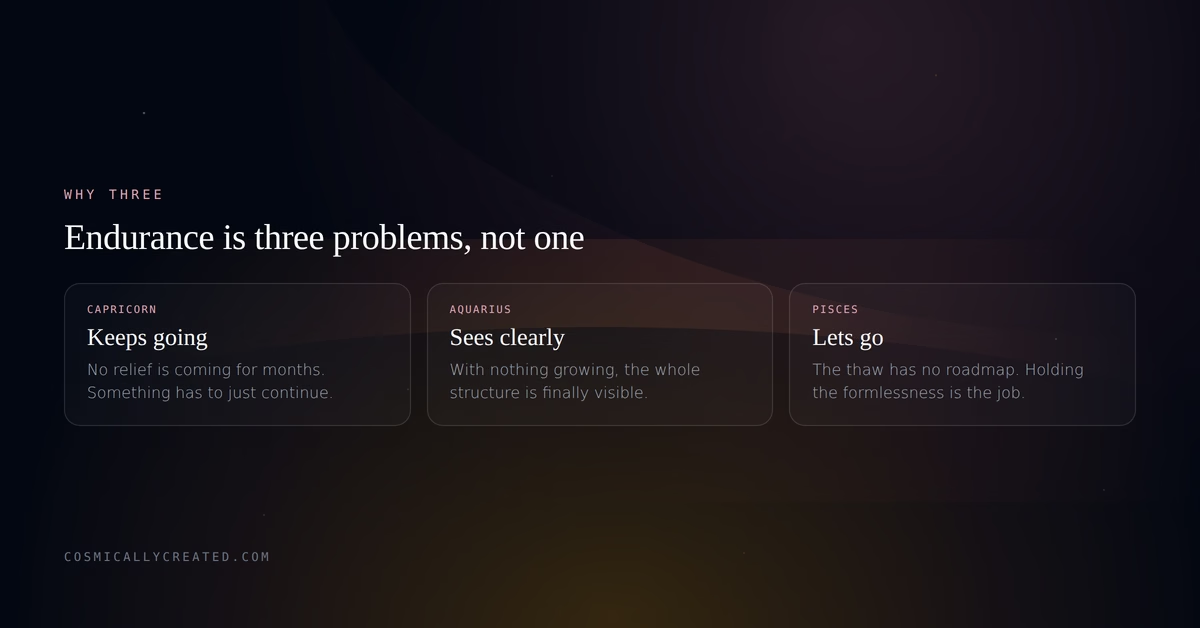
And that requires three completely different survival strategies. Three distinct phases of getting through the impossible.
That’s where Capricorn, Aquarius, and Pisces come in.
These three signs represent three phases of surviving when survival seems impossible. Three strategies for enduring when there’s no end in sight. Three ways of navigating the season when nature itself is hostile to life.
And when you understand them this way—as seasonal survival strategies rather than personality types—everything about these signs suddenly makes sense.
The Paradox of Winter: Life Hidden in Death
Before we dive into each sign, we need to understand the central paradox of winter.
Winter looks like death. But it’s actually dormancy. Everything appears dead, but life is hidden, waiting.
The trees look dead—but they’re alive, just underground in their roots.
The ground looks dead—but seeds are alive, buried and waiting.
The landscape looks dead—but animals are alive, hibernating in dens.
Winter is the season when life survives by becoming invisible. By withdrawing. By appearing dead to avoid actual death.
And this creates a specific kind of challenge:
You have to endure with no evidence that endurance matters. You can’t see growth happening. You can’t see progress. You can’t see that you’re getting closer to spring. You just have to keep going with no reward and no relief.
You have to ration with no certainty you have enough. You can’t know if your stored food will last until spring. You can’t know if spring will come on time or late. You just have to make what you have last as long as possible and hope it’s enough.
You have to maintain discipline when every instinct says to give up. When you’re cold and hungry and tired and there’s no end in sight. When using resources now would feel so good but would doom you later. You have to delay gratification indefinitely with no guarantee the delay will pay off.
Winter requires you to be simultaneously:
- Disciplined and structured despite exhaustion (Capricorn)
- Innovative and systematic despite scarcity (Aquarius)
- Surrendered and trusting despite uncertainty (Pisces)
It’s not just one strategy. It’s a progression through three distinct phases, each with its own way of surviving the unsurvivable.
Let’s walk through them.
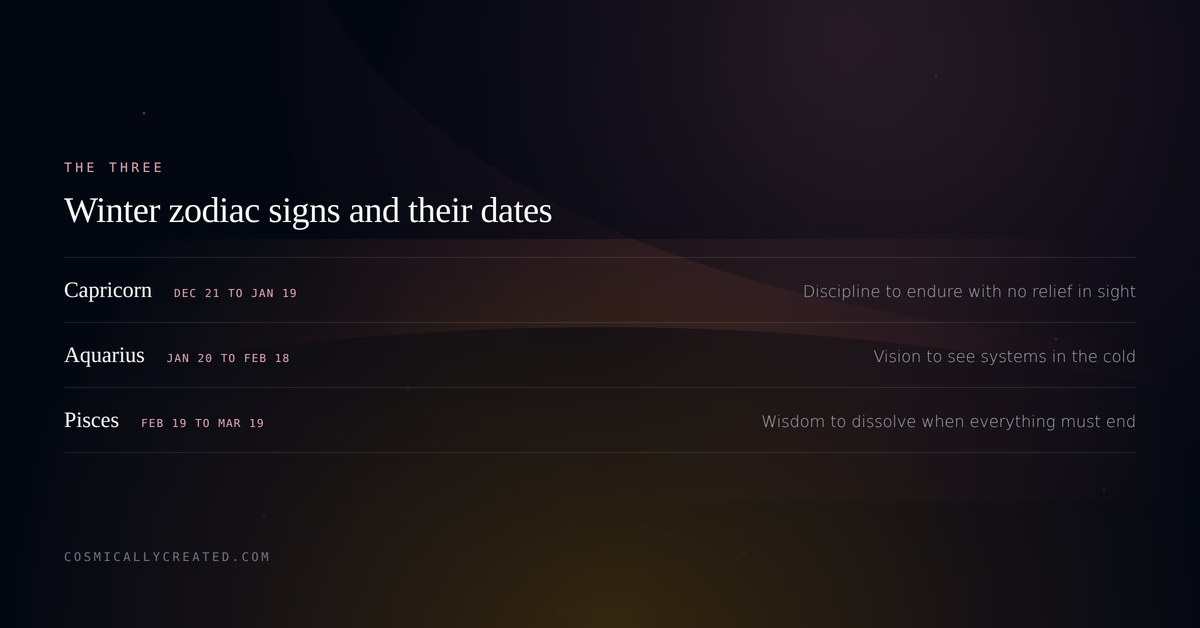
Capricorn (December 22 – January 19): Discipline to Endure With No Relief in Sight
The Environmental Context
It’s late December, early January. The winter solstice has just passed.
And yes—technically, the days are starting to get longer. The light is beginning to return. The solstice marks the turning point from darkness increasing to darkness decreasing.
But you would never know it.
Because here’s what people who don’t live close to nature don’t understand: The coldest, darkest, most brutal part of winter isn’t the solstice. It’s January and February.
The winter solstice happens in late December. But the coldest average temperatures? Mid-January through mid-February.
Why? Because the earth has thermal lag. The ground has been losing heat for months. The cold has been accumulating. The stored warmth from summer has been depleting. By January, you’re at maximum cold, maximum darkness, maximum depletion.
And here’s what makes this phase so brutal: There’s no relief coming. Not for months.
Spring equinox isn’t until late March. Real warmth isn’t until April or May. Food doesn’t start growing until late spring. You’re facing two to three more months of cold, scarcity, darkness with depleted resources.
This is when people die. This is when stored food runs out. This is when fuel runs out. This is when hope runs out.
This is when discipline is the only thing keeping you alive.
That’s the Capricorn moment. That’s deep winter.
The Survival Challenge: Maintaining Discipline When There’s No Reward
Here’s what makes Capricorn hard to understand if you don’t see it seasonally:
Why is Capricorn so focused on discipline, structure, delayed gratification, long-term planning?
It looks like being cold. It looks like being rigid. It looks like refusing pleasure for no good reason.
But that’s not what’s actually happening.
Think about what deep winter requires:
You must ration food. You have what you stored in autumn. That’s it. There’s no more coming. If you eat too much now, you starve in February. If you feed everyone equally, everyone might die. You have to calculate daily rations and maintain them even when you’re hungry.
You must ration fuel. You have whatever firewood you gathered. If you burn it too fast to stay warm now, you freeze later. If you burn it too slow to save it, you might die of cold now. You have to maintain sustainable warmth levels even when you’re freezing.
You must maintain structure. When there’s no external structure—no growing cycles, no daylight variations, no natural rhythms—you have to create internal structure or descend into chaos. Wake at the same time. Eat at the same time. Work at the same time. Structure is survival.
You must delay gratification indefinitely. Every day, you want to use more food, more fuel, more resources. Every day, you have to say no. Not because you’ll be rewarded tomorrow. But because if you don’t say no, you’ll die in six weeks. Delayed gratification with no certain payoff.
You must endure without hope of immediate relief. There’s no “it’ll get better next week.” There’s no “just get through today.” There’s only “maintain discipline for months with no guarantee you’ll make it.”
Deep winter requires rigorous discipline, structured routine, delayed gratification, and long-term endurance when there’s no reward coming and no relief in sight.
That’s Capricorn energy. That’s the survival strategy of deep winter.
What Capricorn Is Actually Doing
So what does this look like in human terms?
Capricorn is doing the essential work of maintaining discipline and structure when external conditions offer no support and no reward.
Not being cold or rigid. But creating internal structure robust enough to endure external chaos. Building discipline strong enough to override immediate impulses that would lead to long-term death.
This is why Capricorn:
Maintains rigorous discipline. Creates rules and follows them. Builds routines and keeps them. Establishes structure and honors it. Not because they’re controlling, but because when external conditions are hostile, internal discipline is what keeps you alive.
Focuses on long-term goals. Plans years ahead. Works toward distant outcomes. Delays gratification for future benefit. Not because they can’t enjoy the present, but because survival requires thinking beyond immediate needs to long-term sustainability.
Values responsibility and duty. Takes obligations seriously. Honors commitments. Does what needs to be done even when it’s hard. Not because they’re martyrs, but because in conditions of mutual dependence, reliability is a survival trait. People die when others fail their responsibilities.
Builds systems and hierarchies. Creates organizational structures. Establishes clear roles. Defines authority and accountability. Not because they’re authoritarian, but because in resource-scarce conditions, efficient organization prevents waste and chaos that kill people.
Achieves through persistence. Keeps going when others stop. Endures past the point of motivation. Continues when there’s no reward. Not because they’re stubborn, but because many things worth achieving require endurance past the point where endurance feels meaningful.
Respects tradition and proven methods. Values what’s worked before. Honors established practices. Respects elders and experience. Not because they’re stuck in the past, but because in life-or-death conditions, unproven methods can kill you. Tradition is survived innovation.
Capricorn isn’t cold or rigid or controlling.
Capricorn is doing the essential work of creating and maintaining the discipline and structure that enables survival when conditions are actively hostile to life.
The Capricorn Challenge: Discipline vs. Rigidity
But here’s where Capricorn struggles:
How do you maintain necessary discipline without becoming rigid? How do you honor structure without becoming trapped by it?
Because here’s the trap: When discipline is what keeps you alive, you can become identified with discipline. When structure is survival, you can mistake any change to structure as a threat to survival.
Immature Capricorn becomes rigid. Follows rules even when they no longer serve. Maintains structure even when it’s become a cage. Confuses discipline with virtue. Mistakes endurance for success. Can’t adapt because adaptation feels like failure.
Mature Capricorn is disciplined but flexible. Maintains structure while adapting to reality. Honors discipline while recognizing when conditions change. Understands that the goal is survival, not perfect adherence to rules. Knows when to adjust the plan.
The Capricorn journey is learning: How do I maintain discipline without becoming enslaved to it? How do I create structure that serves life rather than constraining it?
What Capricorn Needs
Capricorn needs to understand:
Discipline is a tool, not an identity. You’re not more worthy because you endure more. You’re not more valuable because you suffer more.
Structure should serve life, not replace it. Rules that no longer serve should be changed. Traditions that harm should be released.
Success isn’t just reaching the goal. Sometimes surviving the journey is the success. Sometimes adjusting the goal is wisdom, not failure.
Others need from Capricorn:
Respect their discipline. Don’t mock their structure. Their routines might seem rigid to you but they’re how they maintain stability.
Don’t exploit their sense of responsibility. Don’t make them carry weight that isn’t theirs. They will carry it, but it costs them.
Acknowledge the weight they carry. They don’t complain much. That doesn’t mean it’s not heavy.
Give them permission to rest. They won’t take it unless it’s given. And they desperately need it.
Aquarius (January 20 – February 18): Vision to See Systems in the Cold
The Environmental Context
It’s late January, early February.
And we’re at the absolute worst part of winter. The coldest temperatures. The deepest cold. The maximum depletion of resources.
This is statistically the deadliest time of year in northern climates. This is when hypothermia kills. When starvation kills. When illness kills people whose immune systems are compromised by cold and poor nutrition.
This is called “the hungry time.” “The starving time.” The time when stored food runs out and there’s still months until harvest. When fuel runs out and there’s still weeks of cold ahead. When hope runs out and there’s no evidence it’s justified.
And here’s what makes this moment so critical: Individual survival strategies are failing. What worked in early winter isn’t enough now.
You’ve been rationing your food carefully (Capricorn discipline). But you’re running out anyway. You’ve been managing your fuel consciously. But it’s almost gone. You’ve been maintaining your routine. But your body is depleting.
The individual strategies that got you this far won’t get you the rest of the way.
And here’s what happens in human communities at this point: People start sharing. Or people start dying.
You need to share fuel with neighbors. You need to share knowledge about which plants are edible in winter. You need to share care for the sick. You need to share innovation about how to survive.
You need to think systematically about survival, not just individually.
That’s the Aquarius moment. That’s late winter.
The Survival Challenge: Collective Solutions When Individual Strategies Fail
Here’s what makes Aquarius hard to understand if you don’t see it seasonally:
Why is Aquarius so focused on systems, collective good, innovation, intellectual detachment, group solutions?
It looks like being cold or unfeeling. It looks like caring more about ideas than people. It looks like preferring the abstract to the concrete.
But that’s not what’s actually happening.
Think about what late winter requires:
Individual resource hoarding kills everyone. If each family keeps their remaining food private, everyone starves. If everyone guards their remaining fuel, everyone freezes. Collective sharing is the only strategy that allows maximum survival.
Innovation becomes essential. The old methods have been exhausted. You’ve used all the obvious food sources. You’ve burned all the easy-to-find fuel. Now you need new solutions. Creative approaches. Innovations born of necessity.
Pattern recognition saves lives. Who got sick? What did they eat? What patterns connect survival and death? You need people who can step back from individual cases to see systemic patterns. That intellectual detachment isn’t coldness—it’s survival intelligence.
Knowledge sharing is survival strategy. One person discovers that a certain tree bark is edible. If they keep it private, they survive alone. If they share it, the whole group survives. Information wants to be free not because of ideology but because shared knowledge is shared survival.
Group organization matters. Who’s strong enough to gather fuel? Who’s skilled enough to preserve food? Who’s knowledgeable enough to treat illness? Organized collective effort is more efficient than individual effort. Organization prevents waste that kills.
Late winter requires systems thinking, collective solutions, innovation under constraints, and intellectual capacity to see patterns beyond individual circumstances.
That’s Aquarius energy. That’s the survival strategy of late winter.
What Aquarius Is Actually Doing
So what does this look like in human terms?
Aquarius is doing the essential work of seeing systems, creating collective solutions, and innovating when traditional methods fail.
Not being cold or detached. But creating the intellectual space necessary to see patterns, design systems, and innovate solutions that serve collective survival rather than just individual survival.
This is why Aquarius:
Thinks systematically. Sees patterns. Understands how things interconnect. Analyzes systems rather than just individual components. Not because they’re abstract, but because systems thinking reveals leverage points that individual thinking misses.
Focuses on collective good. Considers the group, not just the self. Designs for maximum benefit distribution. Advocates for shared resources. Not because they don’t care about individuals, but because collective survival rate matters more than any single survival during crisis.
Values innovation and progress. Tries new approaches. Questions traditional methods. Experiments with alternatives. Not because they’re contrarian, but because when traditional methods are failing, innovation is the only path forward.
Maintains intellectual detachment. Observes without immediately personalizing. Analyzes without immediately emotionally reacting. Thinks before feeling. Not because they lack emotion, but because emotional overwhelm prevents the clear thinking necessary for innovation.
Champions equality and shared resources. Opposes hoarding. Advocates for distribution. Challenges hierarchies that concentrate resources. Not because they’re ideological, but because in survival conditions, extreme inequality kills both the deprived and eventually destabilizes the hoarders.
Connects people and ideas. Networks. Introduces people who can help each other. Shares knowledge freely. Builds community infrastructure. Not because they’re social, but because connection is how collective intelligence emerges.
Aquarius isn’t cold or unfeeling or preferring ideas to people.
Aquarius is doing the essential work of seeing systems and creating collective solutions when individual strategies have failed.
The Aquarius Challenge: Systems vs. People
But here’s where Aquarius struggles:
How do you think systematically without losing sight of individual humanity? How do you maintain intellectual detachment without becoming actually detached?
Because here’s the trap: When you’re good at systems thinking, you can start seeing people as components rather than beings. When you’re focused on maximum collective benefit, you can lose sight of individual suffering. When you’re maintaining intellectual detachment, you can forget to actually feel.
Immature Aquarius becomes detached from humanity. Sees people as data points. Makes decisions that serve the system but harm individuals. Prioritizes ideas over relationships. Mistakes intellectual understanding for actual connection. Becomes so detached they stop being relatable.
Mature Aquarius sees systems while honoring humanity. Understands that good systems serve people, not the other way around. Maintains intellectual clarity while staying emotionally connected. Innovates for collective good while respecting individual needs. Knows that the best solutions honor both efficiency and humanity.
The Aquarius journey is learning: How do I think systematically while staying humanly connected? How do I innovate for the collective while honoring the individual? How do I maintain clarity without losing compassion?
What Aquarius Needs
Aquarius needs to understand:
Systems exist to serve people, not the other way around. Your perfect solution means nothing if it doesn’t account for human messiness.
Intellectual understanding isn’t the same as emotional connection. You can understand someone’s pain without feeling it. Sometimes feeling it matters.
Not everyone can be as detached as you. Your ability to think clearly in crisis is a gift, but others’ emotional responses are also valid.
Others need from Aquarius:
Value their systemic vision. They see patterns you can’t see. Their insights serve everyone even when they’re hard to hear.
Don’t punish them for their detachment. It’s not coldness. It’s how they maintain the clarity necessary to solve problems.
Let them innovate. Your resistance to change might feel like wisdom but might actually be preventing necessary adaptation.
Bring them back to humanity gently. When they’ve gone too far into abstraction, ground them with specific human stories.
Pisces (February 19 – March 20): Wisdom to Dissolve When Everything Must End
The Environmental Context
It’s late February, moving into March.
And finally—finally—the deep freeze is breaking. The ice is melting. The snow is turning to slush. The ground is beginning to thaw.
Water is everywhere.
Snowmelt running down every surface. Ice turning to liquid. Rivers swelling. Everything wet, dripping, muddy, dissolving.
All those clean, sharp boundaries that winter created? All those solid, defined forms? They’re disappearing.
Ice that was solid is now water. Snow that had structure is now slush. Ground that was frozen solid is now mud. Everything that was rigid is becoming fluid. Everything that was separate is merging. Everything that was defined is dissolving.
And here’s what’s interesting about this moment: You can’t have spring rebirth without winter dissolution. You can’t have new growth without the old structures breaking down completely.
The frozen ground must thaw so seeds can germinate. The ice must melt so water can flow. The snow must dissolve so light can reach the earth. The rigid structures of winter survival must dissolve so the flexible strategies of spring emergence can begin.
This is the transition. The liminal space. The dissolution that enables transformation.
Not death (that was Scorpio). Not endurance (that was Capricorn). Not innovation (that was Aquarius). But dissolution. Surrender. The wisdom of letting solid things become liquid again.
That’s the Pisces moment. That’s late winter, moving toward spring.
The Survival Challenge: Surrendering to Dissolution
Here’s what makes Pisces hard to understand if you don’t see it seasonally:
Why is Pisces so fluid, so boundary-less, so willing to dissolve and merge and surrender?
It looks like weakness. It looks like having no boundaries. It looks like being unable to hold form.
But that’s not what’s actually happening.
Think about what late winter requires:
Winter structures must dissolve. The tight discipline of Capricorn served deep winter survival. But if you maintain that rigidity into spring, you can’t adapt to changing conditions. You have to let the winter structure dissolve to allow spring flexibility.
Boundaries must soften. In deep winter, you maintained sharp boundaries: this is mine, that is yours, this is family, that is not. But as spring approaches and resources start flowing again, rigid boundaries prevent the flow of energy and resources necessary for rebirth.
Ice must become water. Everything that was frozen solid—emotions, resources, connections, structures—must melt. Become fluid. Flow again. What was separated must merge. What was solid must become liquid.
Seeds must absorb water to germinate. You can’t remain sealed and germinate. Seeds that have remained intact and separate all winter must now absorb moisture, swell, break open, lose their separate form to become something new.
The winter self must dissolve to allow the spring self to emerge. You are not the same person who entered winter. You can’t be. You have to dissolve who you became during winter to allow who you’ll be in spring to emerge.
Late winter requires surrender, dissolution, willingness to lose form, trust in the process of transformation, and faith that losing structure doesn’t mean losing self.
That’s Pisces energy. That’s the survival strategy of late winter.
What Pisces Is Actually Doing
So what does this look like in human terms?
Pisces is doing the essential work of dissolution—letting go of old structures so new forms can emerge.
Not being weak or boundary-less. But consciously releasing rigid structures that served survival but now prevent transformation. Choosing to become fluid when solidity is no longer serving.
This is why Pisces:
Has fluid boundaries. Merges with others. Feels what others feel. Can’t always tell where they end and others begin. Not because they’re weak, but because dissolution requires permeable boundaries. You can’t merge while maintaining rigid separation.
Surrenders to larger forces. Goes with the flow. Accepts what is. Doesn’t fight what can’t be changed. Not because they’re passive, but because sometimes resistance prevents the transformation that needs to happen. Sometimes surrender is the active choice.
Embraces the mystical and transcendent. Connects to something larger than self. Seeks unity. Experiences oneness. Not because they’re escapist, but because the experience of dissolution into something larger is what makes letting go of small self possible.
Feels deeply and empathetically. Absorbs others’ emotions. Carries collective pain. Experiences everything as connected. Not because they lack boundaries, but because in the dissolution phase, recognizing interconnection is essential. You are not separate—that recognition matters.
Values creativity and imagination. Lives in possibility. Dreams into being. Imagines what doesn’t yet exist. Not because they’re out of touch with reality, but because imagination is how you bridge from what was to what will be. Dreams are the water that dissolves old structures.
Practices compassion and forgiveness. Releases resentment. Lets go of grudges. Forgives what can’t be changed. Not because they’re doormats, but because holding rigid judgment prevents the dissolution necessary for transformation. Compassion is active release.
Pisces isn’t weak or boundary-less or passive.
Pisces is doing the essential work of conscious dissolution—releasing old forms so new life can emerge.
The Pisces Challenge: Dissolution vs. Dissolution
But here’s where Pisces struggles:
How do you dissolve structures without dissolving self? How do you surrender without disappearing?
Because here’s the trap: When you’re good at letting go, you can lose track of what shouldn’t be let go. When you’re skilled at merging, you can forget that you exist separately. When you’re comfortable dissolving boundaries, you can become unable to maintain any boundaries.
Immature Pisces dissolves self. Has no boundaries. Takes on everyone’s emotions. Can’t say no. Loses themselves in others. Escapes into fantasy, substances, or sleep to avoid the pain of having no structure. Mistakes boundary-lessness for spiritual advancement.
Mature Pisces dissolves structure while maintaining essence. Knows the difference between releasing rigid form and losing core self. Can merge without disappearing. Can surrender without becoming victim. Understands that dissolution serves transformation—it’s not an end state.
The Pisces journey is learning: How do I let structures dissolve without losing myself? How do I surrender without becoming passive? How do I stay fluid without losing all form?
What Pisces Needs
Pisces needs to understand:
You need some boundaries. Not rigid walls, but permeable membranes. Something that lets good through while keeping harm out.
You’re not responsible for everyone’s pain. You can feel it without fixing it. You can witness without absorbing.
Your essence doesn’t disappear when structures dissolve. You’re still you even when you’re fluid. Even water has H2O.
Others need from Pisces:
Honor their sensitivity. It’s not weakness. They feel things you can’t feel. That’s a gift even when it’s painful.
Don’t exploit their compassion. Don’t mistake their forgiveness for permission to harm. Their boundaries are soft, not absent.
Give them space to dream. Their imagination serves everyone. What they envision often becomes real eventually.
Help them ground when they’re too dissolved. Bring them back to body, to earth, to specific reality. They need that.
How the Three Winter Signs Work Together
Okay, so here’s where this becomes really profound.
Capricorn, Aquarius, and Pisces aren’t random personality types. They’re three phases of a single seasonal arc. Three strategies for surviving the complete winter cycle and transitioning back to spring.
And they’re designed to work together as a progression:
Capricorn creates the discipline that enables survival
Without Capricorn’s structure and endurance, you don’t make it through deep winter. You run out of resources. You lose discipline. You die before the thaw comes.
Capricorn gets you through the worst of winter alive.
Aquarius innovates solutions when discipline isn’t enough
Without Aquarius’s systems thinking and collective solutions, individual discipline fails in late winter. You need group strategies. You need innovation. You need to see patterns and create new solutions.
Aquarius creates the collective intelligence that extends survival when individual strategies are exhausted.
Pisces dissolves winter structures to allow spring emergence
Without Pisces’s willingness to let structures dissolve, you stay stuck in winter mode even after winter ends. You can’t adapt. You can’t flow. You can’t germinate. Your winter survival structures become your spring prison.
Pisces creates the dissolution that makes transformation possible.
They form a complete cycle:
Endure → Innovate → Dissolve → Emerge
Maintain discipline through the worst. Create collective solutions when individual strategies fail. Release rigid structures when they’ve served their purpose. Allow new forms to emerge.
That’s the winter progression. That’s how you survive the unsurvivable and transition back to life.
Why You Need All Three Winter Strategies
And here’s what matters most:
You can’t skip any of these phases. You need all three strategies to navigate winter successfully.
If you only use Capricorn energy:
You endure and endure and endure but you never innovate. You maintain discipline but you become rigid. You structure but you can’t adapt when conditions change.
You end up surviving winter but unable to transition to spring. Still rationing in May when food is growing. Still maintaining rigid structure when flexibility is needed. Still enduring when it’s time to thrive.
If you only use Aquarius energy:
You innovate and create systems but you lack the discipline to implement them consistently. You see solutions but you can’t endure the grind of making them work.
You end up with brilliant ideas that never get executed. Perfect systems that nobody maintains. Collective solutions that fail because individuals won’t do the hard work of discipline.
If you only use Pisces energy:
You dissolve and surrender and flow but you have no structure to dissolve FROM. You have no boundaries to soften. You merge into nothing because you never had form to begin with.
You end up dissolved to the point of non-existence. So fluid you’re formless. So surrendered you’re passive. So open you’re a vessel for everything that flows through with no discernment.
But when you work with all three:
You build the discipline and structure to survive the worst (Capricorn), you innovate collective solutions when individual strategies fail (Aquarius), you dissolve old structures to allow new emergence (Pisces).
You endure, you innovate, you transform.
That’s mastery of winter. That’s surviving the unsurvivable and emerging ready for spring.
The Wisdom of Winter
So what’s the actual wisdom these signs are teaching us?
Winter teaches us how to endure the unsurvivable. How to maintain discipline with no reward. How to innovate under constraint. How to surrender when surrender is the only path forward.
How to structure when structure is survival. How to think systematically when individual strategies fail. How to dissolve when dissolution enables transformation.
These aren’t just personality traits. These are essential life skills.
You need to know how to maintain discipline when there’s no immediate reward coming. (Capricorn)
You need to know how to think systematically and create collective solutions when individual strategies fail. (Aquarius)
You need to know how to let structures dissolve when they’ve served their purpose so transformation can happen. (Pisces)
These skills determine whether you can survive the dark times and emerge ready to thrive again.
Because here’s the thing about winter: It ends. It always ends. Spring always comes.
But whether you survive to see spring depends on whether you mastered winter’s lessons:
Did you maintain the discipline to ration and endure? (Capricorn)
Did you innovate collective solutions when individual strategies failed? (Aquarius)
Did you let go of winter structures when they started preventing spring emergence? (Pisces)
That’s what determines whether winter’s death becomes spring’s rebirth.
How to Work With Winter Energy
So how do you actually work with these energies?
When you’re in a Capricorn phase:
- Ask: What discipline do I need? What structure serves survival? What must I endure?
- Build routines that support long-term endurance
- Maintain discipline even when there’s no immediate reward
- Honor responsibility and commitment
- Remember: Discipline serves life—it’s not virtue for its own sake
When you’re in an Aquarius phase:
- Ask: What patterns am I seeing? What systems need changing? What collective solutions exist?
- Think beyond individual circumstances to systemic patterns
- Share knowledge and resources
- Innovate when traditional methods aren’t working
- Remember: Systems serve people—not the other way around
When you’re in a Pisces phase:
- Ask: What structure needs to dissolve? What am I holding onto that prevents transformation? What needs to flow?
- Release rigid boundaries that no longer serve
- Surrender to the transformation process
- Trust that dissolution isn’t death—it’s transition
- Remember: Your essence remains even when form dissolves
And recognize when you need to shift:
Too disciplined, too rigid? Move toward Aquarius or Pisces—let some structure dissolve or innovate new approaches.
Too dissolved, too formless? Move toward Capricorn—build some structure to contain yourself.
Too systematic, too detached? Move toward Pisces—reconnect to feeling and flow.
Too isolated in individual endurance? Move toward Aquarius—seek collective solutions.
Holding onto winter strategies in spring? Move toward Pisces—let the old structures dissolve.
The wisdom is knowing which phase you’re in and what that phase requires.
The Winter Question
So here’s the question winter asks you:
Can you endure with no relief in sight? Can you innovate under constraint? Can you surrender when surrender is the path forward?
Can you maintain discipline when there’s no reward? Can you see systems when you’re suffering? Can you let go of structure when structure has become prison?
Can you survive the unsurvivable and emerge transformed?
That’s the challenge of winter.
That’s what Capricorn, Aquarius, and Pisces are teaching.
That’s the wisdom of the season of endurance.
The Bridge Back to Spring
And here’s what’s most important to understand:
Winter’s end is spring’s beginning. Pisces’s dissolution is Aries’s emergence.
The water that melts from snow (Pisces) is what allows seeds to germinate (Aries).
The structures that dissolve (Pisces) create space for new growth (Aries).
The old self that surrenders (Pisces) allows the new self to emerge (Aries).
Winter and spring aren’t separate. They’re one continuous cycle.
You endure the darkness (Capricorn). You innovate in the depths (Aquarius). You dissolve the old structures (Pisces). And then—you emerge into the light again (Aries).
And you bring with you everything you learned during winter:
- The discipline to endure
- The vision to see systems
- The wisdom to let go
That’s what makes your spring emergence wiser, stronger, more capable than your last spring emergence.
You’ve survived another cycle. You’ve endured another winter. You’ve died and been reborn again.
And you’re ready to begin again.
Because here’s the deepest truth:
The cycle never ends. Spring becomes summer becomes autumn becomes winter becomes spring again.
Emergence becomes fullness becomes release becomes endurance becomes emergence again.
Birth becomes growth becomes death becomes rebirth.
That’s what the zodiac is teaching us.
Not twelve personality types. But twelve phases of the eternal cycle of life, death, and rebirth that we all move through, again and again.
And the wisdom is knowing: Where am I in the cycle? What does this phase require? And can I trust that the cycle continues even when I can’t see what’s coming next?
That’s the work.
That’s the wisdom.
That’s what winter teaches.
Want to explore your specific winter placements? If you have Capricorn, Aquarius, or Pisces in your chart, understanding these seasonal strategies can help you work with your placements more consciously. And if you struggle with any winter energy, now you know what survival challenge you’re actually facing—and why it matters.
Drop a comment: Which winter energy do you find easiest? Which one challenges you most? Which phase of endurance do you need to develop? And what did winter teach you about survival?