
The Capricorn full moon, and what it audits
A Capricorn full moon happens once a year, in late June or July, when the sun is in Cancer and the moon is directly opposite it in Capricorn. It lights up the axis between what shelters you and what you have built, and it almost always arrives as an audit rather than a celebration.
Every full moon is the sun and the moon at opposite points of the zodiac. Which means every full moon lights up an axis rather than a single sign, and the axis is the whole story.
This one lands in the middle of summer. The sun sits in Cancer, the first month of summer, the stretch about building shelter while there is still time. The moon sits opposite in Capricorn, the middle of winter, the stretch about enduring with no relief in sight.
So this one puts the softest month of the year directly across from the hardest. That tension is not incidental. It is the entire reason this lunation feels the way it does.
Why the Cancer and Capricorn axis reads as an audit
Cancer and Capricorn sit exactly six months apart, which makes them opposite conditions in the most literal sense. One opens summer at the solstice with maximum light. The other opens winter at the solstice with minimum light. Same event, opposite ends.
What they share is that both are about protection. Cancer protects by sheltering, by holding the people inside the structure, by making somewhere safe. Capricorn protects by building the structure itself, by enduring, by making sure the thing holds under load.
A full moon on that axis asks the same question every year, and the question is uncomfortable: is what you built actually holding the people it was supposed to hold.
That is why nobody experiences this one as a soft evening. It is the moon in the sign of consequences, sitting opposite the sign of care, at the exact point of the year when everything is at full output and there is nowhere left to hide.
| Cancer, where the sun is | Capricorn, where the moon is | |
|---|---|---|
| Season | The first month of summer | The first month of winter |
| Protects by | Sheltering the people | Building the structure |
| Asks | Who needs holding | Will it hold under load |
| Failure mode | Holding on past the point | Enduring something that should end |
Three things a Capricorn full moon tends to bring up
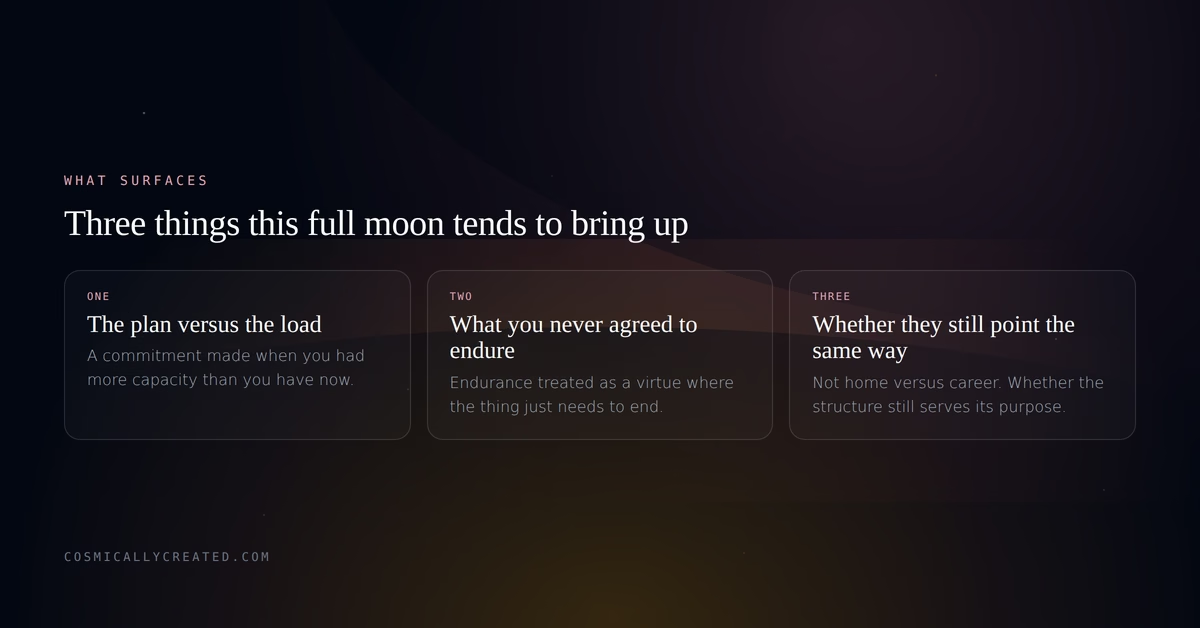
1. The gap between the plan and the actual load
Capricorn is the sign of structures under pressure. A full moon there tends to reveal the thing that was fine in theory and is quietly buckling in practice. Usually a commitment made when you had more capacity than you have now.
2. What you are enduring that you never agreed to endure
The Capricorn shadow is treating endurance as a virtue in situations that simply need to end. This full moon is very good at making that distinction visible, which is why it often reads as the week somebody finally admits something out loud.
3. Whether the ambition and the shelter are still pointed the same way
The axis is not asking you to choose between career and home, which is the flat version of this you will see everywhere. It is asking whether the structure you built is still serving the thing it was built for. Those are different questions and only one of them is useful.
Working with it instead of bracing for it
Full moons are not events that happen to you. They are a point in a cycle that has been building for two weeks and takes about three days either side to resolve. The practical version is small.
- Do not start anything. This is the culmination point of a cycle, not the opening of one. Whatever this moon surfaces has been true for a while.
- Write down what you notice yourself resenting during that week. Capricorn resentment is almost always information about a structure that stopped fitting.
- Do not make the decision on the night. Full moon weeks run hot and Capricorn is not a sign that benefits from a fast call. Write it down, decide in ten days.
- Check whether the thing you are enduring has an end date. If it does not, that is the actual finding.
If you want the wider frame, this is the seasonal astrology framework, and the two signs involved have full reads at Cancer and Capricorn. The precise time of the full moon in your timezone is on the published moon phase tables.
What the June 2026 Capricorn full moon looked like
This is the dated section. Leave it in place as a worked example and add a new one underneath each year rather than replacing the page.
Worth keeping as a worked example, because it was an unusually loaded one and it shows how much of a full moon’s character comes from what else is happening that day rather than from the lunation on its own.
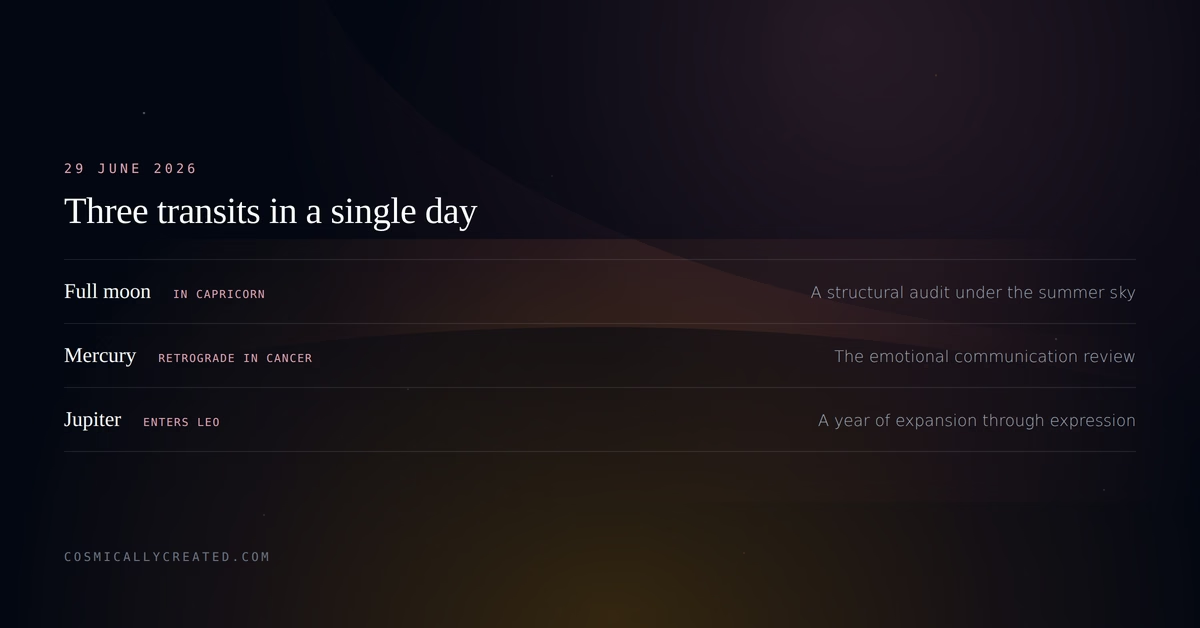
What actually happened on 29 June 2026
The full moon was exact at 7:56pm Eastern, with the moon at 8 degrees of Capricorn and the sun at 8 degrees of Cancer.
Six hours earlier, at 1:35pm Eastern, Mercury stationed retrograde at 26 degrees of Cancer. So the day held two events, and the second one landed while the first was still settling.
The following morning, Jupiter left Cancer and entered Leo for the first time since 2014.
Three things inside about eighteen hours, and all three of them concerned the same part of the year. Mercury turning back in Cancer, the moon lighting the Cancer and Capricorn axis, and Jupiter finishing a year in Cancer and moving on.
Why that combination was heavier than usual
The lunation itself was squaring both Saturn and Neptune, which is a specific and unhelpful pairing. Saturn square a full moon is a hard limit. Neptune square a full moon is a lack of clarity. Together they produce the feeling of being definitely blocked by something you cannot quite identify.
Then Mercury stationing retrograde in Cancer on the same day meant that anything anybody worked out that week was provisional. Stations are not gentle. The days either side of one are usually where the confusion is thickest.
And Jupiter leaving Cancer the next morning closed a chapter that had been running since June 2025. Whatever the previous year had been about in terms of home, family or safety, that was the week it stopped being the live subject.
What to actually do with a day like that
The advice I gave at the time still stands, and it is the same advice for any heavily loaded lunation.
- Notice, do not decide. A full moon shows you the finding. It is a terrible day to act on it, and with Mercury stationing that week it was worse than usual.
- Write down what surfaced and put a date on it. Ten days later is a reasonable point to reread it and see whether it still reads as true.
- Treat anything decided in the seventy two hours around a Mercury station as a draft rather than a conclusion.
- Ask what has quietly finished. Jupiter changing signs makes that question unusually easy to answer, because something will have run out of energy without announcing it.
The next Capricorn full moon falls in the same window the following year, in late June or July. Check a current moon phase table for the exact time in your timezone, and read this section as a worked example rather than a forecast.
Where it sits in the two week cycle
A lunation never arrives on its own, and knowing what came before it explains most of what it feels like.
Two weeks earlier there was a new moon in Cancer, sun and moon together at the start of summer. That is the beginning of the cycle, and Cancer new moons are about deciding what to protect and who is inside the circle.
Whatever was set in motion then is what comes to a head at this full moon. Not a new subject. The same subject, arriving at the point where it can be assessed.
Then two weeks after, the cycle closes with a new moon in Leo and the year moves on to a different question entirely.
So the useful reflex is to look backwards rather than forwards. Ask what you decided, committed to, or quietly agreed to around the Cancer new moon, because that is almost always what the audit is about.
People who track this get much more out of full moons than people who treat each one as a standalone event, and it costs nothing but writing two dates in a calendar.
There is a longer version of the same logic, too. The moon returns to Capricorn every month, for two or three days, and most people never notice those. What makes this one legible is that the sun is in the opposite sign, so the two halves of the axis are lit at the same time and you get to see both at once.
Every other month, the moon passes through Capricorn while the sun is somewhere else entirely, and the structural question gets asked quietly with nothing illuminating the other side of it. Once a year the whole axis is visible in the same evening, which is the only reason this particular pass is worth writing about.
Three things this full moon is not
It is not a manifesting window
Manifesting language belongs to the start of a cycle, not the culmination of one. Setting an intention here is beginning a race at the finish line, and it is the most common thing people get backwards.
It is not a crisis
Whatever surfaces has been true for a while. The lunation does not create the problem, it removes your ability to keep not looking at it, and those two things feel identical in the moment and are not the same.
It is not everybody’s week
One point in the sky opposing another point in the sky is only your event if you have something near those degrees. Content that tells all twelve signs this will be intense is describing weather rather than a chart.
The honest version of what this transit does is smaller and more useful than the dramatic version. It puts a light on a structure once a year and asks whether the structure is still doing its job. That is worth an evening of attention and it is not worth a week of dread.
I want to be careful about the claim I am making here too. I am not telling you the moon changes your mood, and I am not going to pretend I can demonstrate a mechanism for any of this. What I can say is that an annual marker on the shelter and structure axis is a genuinely useful thing to have in a calendar, and that people who check in on the same question once a year tend to notice a drift they would otherwise have carried for another decade.
Read it as a scheduled review rather than a cosmic verdict. The date is fixed, the question is always the same, and the value is entirely in the fact that you would not otherwise stop to ask it.
How a full moon actually works, briefly
Worth saying once, because most full moon content skips it and then the advice comes out backwards.
A full moon is the moment the moon sits directly opposite the sun, which is why it is fully lit from where we stand. It is the halfway point of a cycle that started at the previous new moon about two weeks earlier and finishes at the next one about two weeks later.
That makes it a culmination rather than a beginning. Whatever surfaces has been building since the new moon, and quite often for much longer than that. Nothing arrives out of nowhere on a full moon. It just becomes impossible to keep not looking at.
The practical consequence: full moons are for noticing and finishing, new moons are for starting. Setting intentions on a full moon is starting a race at the finish line, and it is the single most common thing people get the wrong way round.
Is what you built actually holding the people it was supposed to hold?
Questions about the Capricorn full moon
When is the Capricorn full moon?
Once a year, in late June or July, whenever the moon reaches the point in Capricorn directly opposite the sun in Cancer. The exact date moves each year, so check a current moon phase table for the time in your timezone.
What does a Capricorn full moon mean?
It lights the axis between shelter and structure. Cancer holds the people, Capricorn builds the thing that holds them, and the full moon asks whether what you built is still doing that job.
Why does this full moon feel harder than others?
Because Capricorn is the sign of consequences and it is sitting opposite the softest month of the year. There is nowhere to put the finding. That is a design feature of the axis rather than a bad transit.
Does this lunation affect everyone?
Only loosely unless you have something near that degree in your own chart. It is one point in the sky hitting one point in a chart. If you have nothing near it, most of this is background weather rather than your week.
Should I make a decision on a Capricorn full moon?
Notice, write it down, decide about ten days later. Full moon weeks run hot and Capricorn is not a sign that rewards a fast call.
Is a full moon a good time to set intentions?
No, and this is the most common thing full moon content gets backwards. A full moon is the culmination of a cycle. The new moon is the opening. Setting intentions at a culmination is starting a race at the finish line.
Whether this one is actually pointed at you
Everything above is the axis in general. Whether it lands on you personally depends on what sits near that degree in your chart, and that is a specific question rather than a general one.
The Season Map is free, six pages, no birth time required. It shows you which stretches of your own year are loaded and which ones hold nothing, including whether you are sitting on this axis at all.
Keep reading
Want your own year mapped out like this?
A Season Map is six pages built from your birth chart. It lays your year out as a calendar: the weeks that are loaded, the months that hold nothing at all, with real dates. It costs nothing and I write them by hand.
You are on the list.
Your Season Map is being written by hand, so give it a few days. It lands from Jakayla at cosmicallycreated.com, so keep an eye out for that name.