
Why your birth time matters, down to the minute
Your birth time sets the rising sign, which turns over roughly every two hours and decides which house every planet in your chart falls into. Change the time by a few hours and you keep every placement by sign and lose the entire structure around them.
Of the three inputs a chart takes, the birth time is the one people most often do not have, and it is also the one that does the most work.
That is an unfair arrangement and I am sorry about it. Date and place are usually easy. The time is sitting on a document somebody filed thirty years ago, or in the memory of a person who was not at their most observant that day.
But it is worth chasing, and this is the case for why. Not because a chart is useless without it, which is untrue, but because of what specifically appears when you have it.
The structure underneath why your birth time matters
The earth rotates once every twenty four hours. All twelve signs pass over the eastern horizon in that time, which works out at roughly one sign every two hours.
Whichever sign was coming up at the moment you were born is your rising sign, and it becomes the first house of your chart. The other eleven houses follow it in order around the wheel.
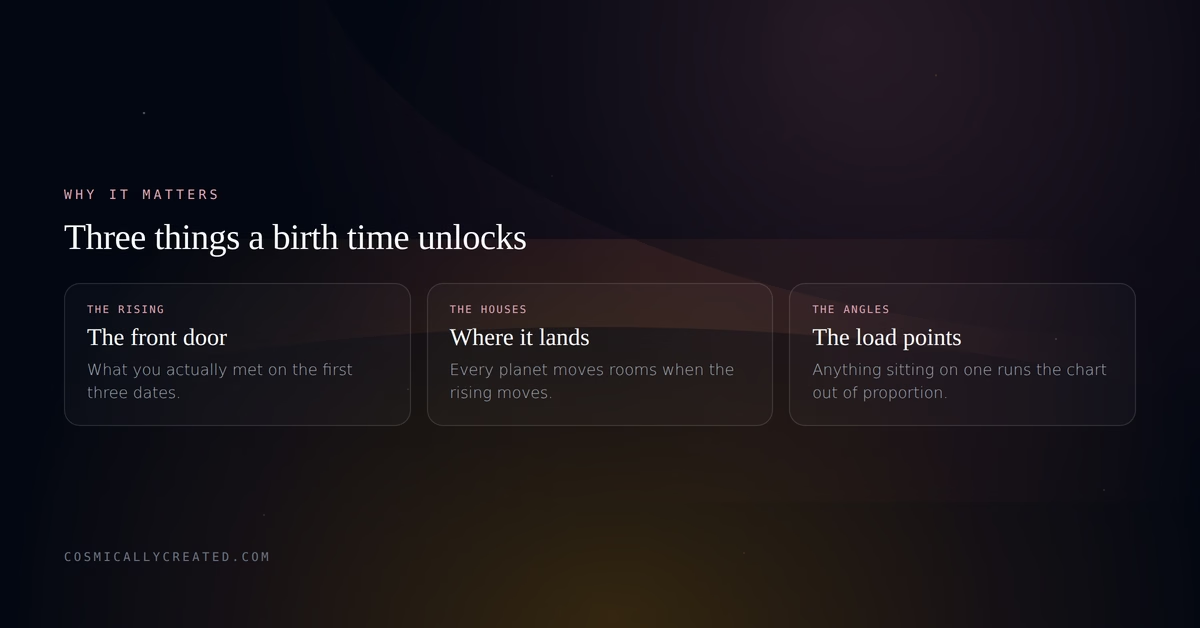
So the birth time is not adding one more placement to a list. It is deciding the frame that every other placement sits inside.
Two people born on the same day in the same city, one at seven in the morning and one at seven in the evening, have the same sun, nearly the same Mercury and Venus and Mars, possibly the same moon sign. And every single one of those planets is in a different house.
That is why your birth time matters more than any individual planet does. It is structural rather than additive.
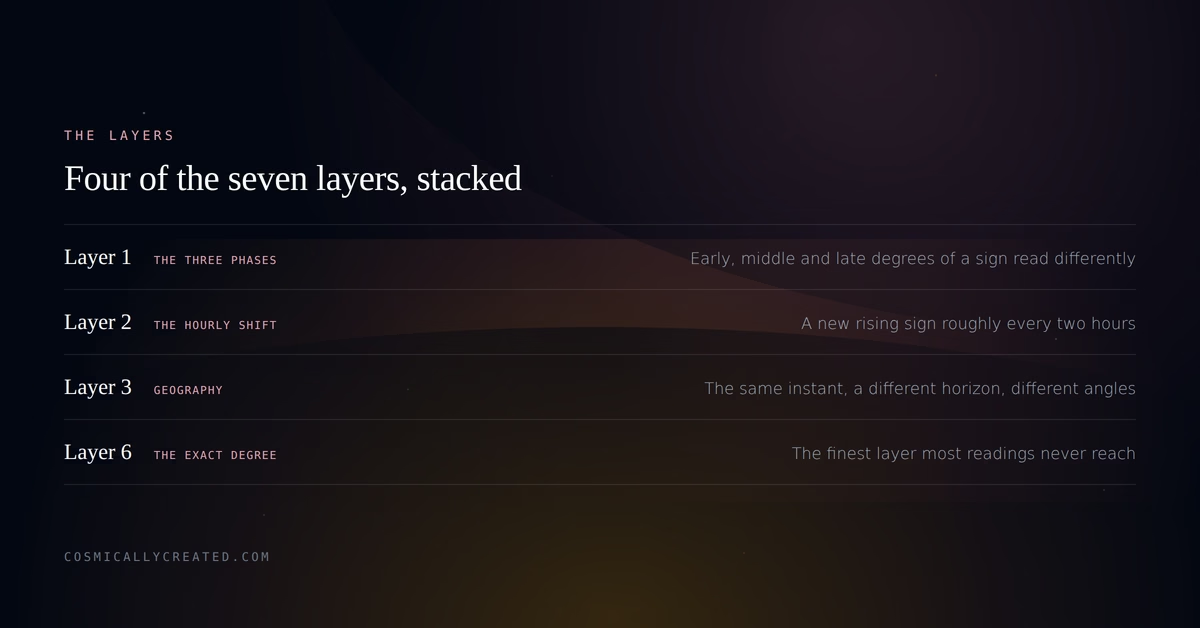
The seven things a birth time gives you
1. The rising sign
The sign people actually meet. If you have ever been told you do not seem like your sun sign, the person describing you was almost certainly describing this, and they were being accurate.
2. The house of every planet
Where each department plays out. A Capricorn moon in the fourth house and the same moon in the tenth describe two very different lives running identical astrology.
3. The midheaven
The point directly overhead at that moment, read as public role and what you are visibly for. It moves faster than the rising and is one of the more accurate points in a chart.
4. The descendant and the imum coeli
The other two corners of the frame. One describes what you go looking for in other people, the other describes the private base underneath everything.
5. The exact degree of the moon
The moon moves about twelve degrees a day, so a chart with no time can leave it in either of two signs if the birth fell near a boundary. The time settles it.
6. Which houses are empty
Ten planets and twelve houses means some rooms are always empty, and which ones depends entirely on where the first house starts. No time, no answer.
7. Real timing work
Transits to the angles, progressions and anything else that runs on exact positions all need a time. Without one you can still read transits by sign, but the precise version is not available.
What you can still read without one
Now the reassuring half, because people arrive at this genuinely upset and it is not warranted.
Without a birth time you still have every planet by sign, which is most of the useful picture. Your sun, your Mercury, your Venus, your Mars, your Saturn, all of it, exactly as accurate as anybody else’s.
The standard workaround is a chart cast for noon, which puts the moon in the middle of its likely range and gets it right most of the time. Some astrologers use sunrise instead, which sets the sun on the ascendant. Both are conventions rather than claims.
What you should do is treat everything angle based as unconfirmed. Do not read your houses. Do not take a rising sign description seriously. If a reading leans on either, it is building on a foundation that was assumed rather than known.
And be a little suspicious of anyone who tells you a chart is worthless without a time. It is not worthless, it is lower resolution, and the difference between those two statements is where a lot of unnecessary spending happens.
How to actually find your birth time
It is findable more often than people assume, and it is worth an afternoon.
The long form birth certificate
This is the first place to look. In many places the short certificate omits the time and the long form includes it, and most people have only ever seen the short one. Ordering the long form is usually a form and a small fee.
Hospital records
Hospitals keep delivery records for a long time and the time of birth is on them. Requesting your own medical records is a right in most countries and the process is more routine than it sounds.
Baby books and old paperwork
Baby books frequently have it written on the first page. So do birth announcements, hospital bracelets kept in a drawer, and the odd christening card.
Asking, carefully
Ask what else was happening rather than asking for a number. Was it light outside. Had anyone eaten. Did somebody miss work. People reconstruct a time from context far more reliably than they recall it directly.
If none of that produces anything, stop. An approximate time you have talked yourself into is worse than no time at all, because you will read the houses as though they were real.
How exact does it actually need to be
More exact than people want and less exact than the anxiety suggests.
The rising degree moves about one degree every four minutes. So four minutes is genuinely a difference at the level of degrees, and being an hour out will usually put you in a different sign entirely.
In practice, within about ten minutes is fine for almost everything. You will have the right rising sign, the right houses and a midheaven you can rely on. That is the whole practical picture.
Where it gets tighter is if you were born near a sign boundary on the ascendant, in which case ten minutes can flip you, and you will know because two charts cast ten minutes apart will look completely different.
Anybody promising meaningful precision beyond the minute is overselling. Clocks in delivery rooms are not synchronised to anything and the time recorded is the time somebody looked up and wrote down.
That is not a flaw in the method. It is just what the data is, and being honest about the resolution of your inputs is part of taking the whole method seriously.
Time zones and daylight saving, the mistake that ruins charts
This is the single most common reason somebody has a wrong chart while believing they have a right one.
The time written on a certificate is local clock time. What the calculation actually needs is the corresponding universal time, which means the software has to know the time zone that applied at that place on that date, including whether daylight saving was in effect.
That sounds automatic and it very often is not, because the rules have changed constantly. Countries have shifted their zones. Daylight saving has been introduced, abolished and reintroduced. Some places ran it during wars and not afterwards. Some regions inside a country observed it while their neighbours did not.
An hour of error moves your rising by half a sign, and if you were born in the second half of a sign it moves you into the next one entirely.
The practical version is simple. Use software with a proper historical time zone database rather than one that applies today’s rules to a date decades ago. Enter the place of birth as a place, not as a manual offset you worked out yourself. And if your chart has always felt slightly wrong in a way you cannot name, check this before you check anything else.
I have seen more charts corrected by a daylight saving fix than by any other single thing.
Early and late degrees, the layer most readings skip
Once you have a time you have degrees, and degrees are where this gets genuinely interesting to me.
Every sign is thirty degrees wide, and a sign is a stretch of weeks in the year rather than a uniform block. So a planet at one degree of a sign and a planet at twenty nine degrees are in the same sign and in quite different parts of the same season.
One degree of Taurus is the first days of that stretch, when the previous month has only just ended and the shift into rooting is barely underway. Twenty nine degrees of Taurus is the last day before it hands over to Gemini, with the acceleration already audible.
Read that way, the difference stops being an abstraction. Early degrees of any sign carry something of what it was like to have just arrived. Late degrees carry the pressure of what is coming next.
It also explains the cusp question properly. There is no such thing as being born on a cusp in the technical sense, because your sun is in exactly one sign. What is true is that a planet in the last couple of degrees of a sign is at the end of that stretch of the year, and that is a real position with a real character.
None of this is available without a birth time for the fast moving points, which is one more entry on the list.
Is chasing the time actually worth the trouble
People ask me this and the answer depends on what they want out of a chart, so here is the honest split.
If you want to understand your own patterns, the sign level gets you most of the way there. Sun, moon, Mercury, Venus, Mars by sign is a very substantial picture and plenty of people work with nothing else for years.
If you want to understand where those patterns show up in a life, you need the houses, and the houses need the time. The difference between knowing you have a Capricorn moon and knowing it sits in your fourth house is the difference between a description and an explanation.
And if you want timing of any kind, transits to the angles, progressions, anything that answers when rather than what, the time is not optional.
So the real question is which of those three you are actually after. Most people asking about their chart want the second one, they just have not been told that is what they want, and they end up frustrated with sign level readings that were never designed to answer it.
An afternoon on the paperwork is a small price for that, and unlike almost everything else in this subject it is a one time cost.
The time does not add a placement. It decides the frame every placement sits inside.
Rectification, and what it can honestly do
Rectification is working backwards from known events in a life to estimate an unknown birth time.
The method is straightforward in principle. Major events tend to coincide with transits to the angles, so an astrologer takes a set of dated events, tests candidate times, and finds which one produces a chart where the timing lines up.
It is genuinely useful and I want to be clear about its status. The result is an estimate. A well done rectification narrows a twelve hour window to a plausible half hour, which is a real achievement, and it is still a reconstruction rather than a record.
So treat a rectified chart as a working hypothesis. Read the houses lightly. If several years of it keeps describing your life accurately, it is probably close. If it keeps missing, the time is wrong rather than the astrology.
What I would not do is pay a large amount for one before you have exhausted the paperwork. The long form certificate costs very little and it is a record rather than an inference.
Questions about why your birth time matters
Why does my birth time matter so much?
Because it sets the rising sign, which turns over roughly every two hours and resets which house every planet falls into. Change the rising and you change the structure of the whole chart.
What if I do not know my birth time?
You can still read every planet by sign, which is most of the useful picture. You lose the rising sign, the houses and the angles, so treat anything that depends on those as unconfirmed.
Can I find my birth time?
Often yes. In many places it is on the long form birth certificate rather than the short one, and hospital records sometimes hold it. It is worth the afternoon it takes.
Does the exact minute really matter?
For the rising degree, yes. For most practical reading, being within about ten minutes is fine. Anyone promising precision beyond that is overselling what the data can support.
What is chart rectification?
Working backwards from known life events to estimate an unknown birth time. It is genuinely useful and it is also an estimate, so treat the result as a working hypothesis rather than a record.
Do early and late degrees of a sign read differently?
Yes, and this is the layer most readings skip. The first few degrees of a sign behave differently from the last few, because they sit at different points inside that stretch of the season.
Season boundaries move by a day some years, because the equinoxes and solstices drift against the calendar.
See it in your own chart
The Season Map is free, six pages, and it needs no birth time at all, which is deliberate. It lays out all twelve seasons in the order the year runs and shows you how much of your own chart each stretch touches.
If you have your time and you want the full read written for your chart specifically, that is The Seasonal Blueprint.
Keep reading
Want your own year mapped out like this?
A Season Map is six pages built from your birth chart. It lays your year out as a calendar: the weeks that are loaded, the months that hold nothing at all, with real dates. It costs nothing and I write them by hand.
You are on the list.
Your Season Map is being written by hand, so give it a few days. It lands from Jakayla at cosmicallycreated.com, so keep an eye out for that name.