
What the planets mean, one at a time
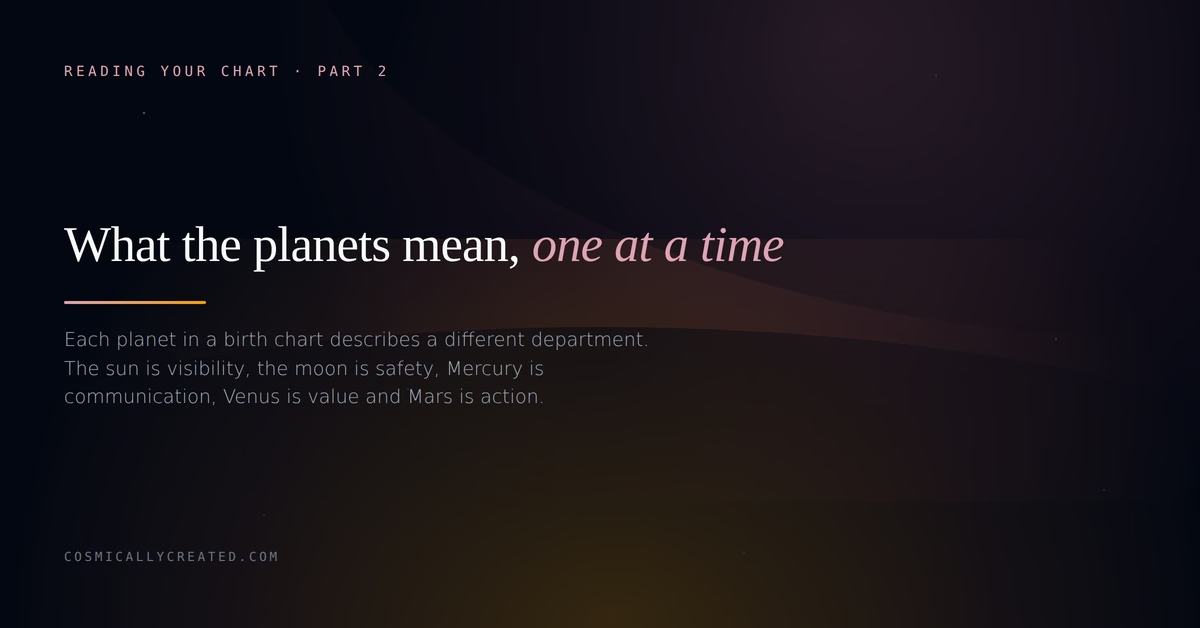
Each planet describes a different department. The sun is what you are practising, the moon is what you need when things go wrong, Mercury is how you think, Venus is what you value and Mars is how you act. The sign tells you the strategy, the house tells you where it plays out.
The reason charts feel overwhelming is that everybody learns them in the wrong order. Ten symbols arrive at once with a keyword list attached and none of it connects to anything.
So take it one at a time, and hold onto a single rule while you do it.
The planet is the department. The sign is the strategy it runs. The house is where it happens.
That one sentence does most of the work of understanding what the planets mean. Everything below is that rule applied ten times.
The structure underneath what the planets mean
Take one placement and pull it apart. Venus in Aries in the eighth house.
Venus is the department, which is value, taste, and how you go about wanting things. Aries is the strategy, which is immediate, direct, and decided before the deliberating starts. The eighth house is where it plays out, which is the area of deep exchange and the things people do not say out loud.
So that is a person whose wanting is instant and total, applied to the least casual part of life.
That happens to be mine, sitting next to a Pisces sun, and the two of them do not agree. The wanting has already made up its mind while the rest of me is still dissolving into the question, which is a specific kind of daily comedy.
Notice what that reading did not do. It did not tell you whether I am a good person or what will happen to me. It described how a department operates. That is the whole scope of what the planets mean, and everything more dramatic than that is somebody adding claims.
The five that are actually about you
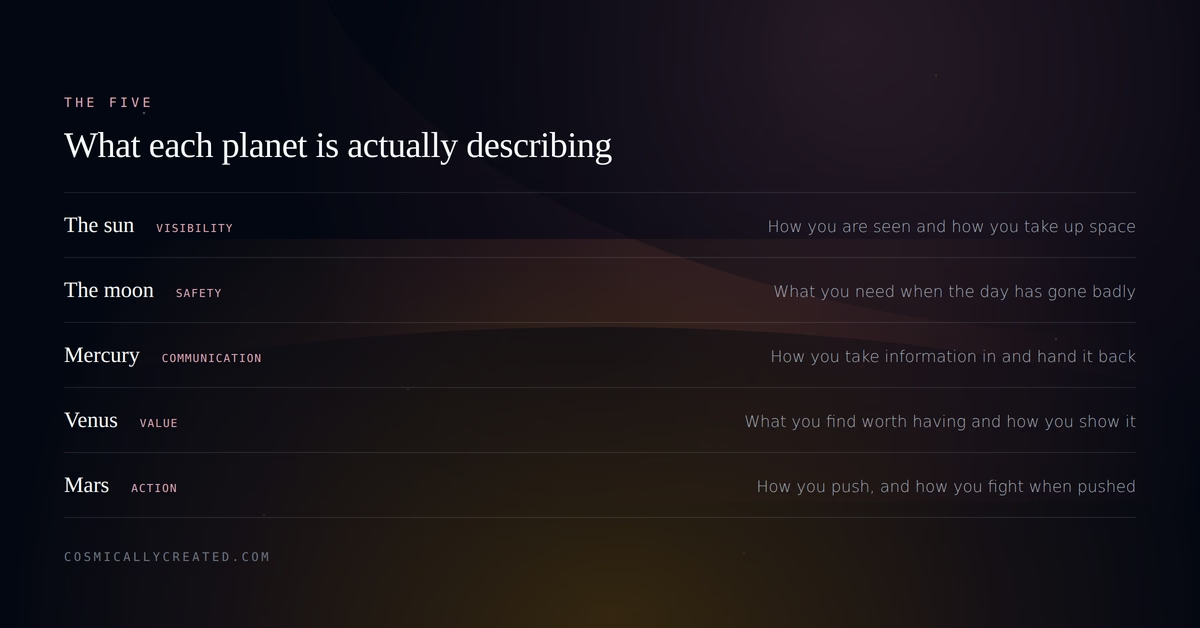
Five move fast enough to be personal rather than generational. These are the ones worth learning properly.
The sun, what you are practising
The most famous placement and the third most useful one. Read as a strategy rather than a personality it makes far more sense, because it describes what you are working on rather than what you have already achieved. That is also why so few people relate to their sun sign description.
The moon, what you need when things go wrong
This is the one I would read first on anybody. The moon changes sign every two and a half days and describes the interior, the thing that has to be true for you to be steady. Ask what somebody needs on their worst day and you are asking about their moon.
Mercury, how you think and how you say it
Not intelligence. Processing style. Whether you think out loud or silently, in structures or in associations, quickly or thoroughly. Mine is in Aquarius, which means I understand a thing by getting far enough away from it to see the shape, and I am no use at all in the middle of a situation until I have done that.
Venus, what you value and how you relate
Taste, money, affection, and the standard by which you decide something is worth having. Venus never travels more than about 47 degrees from the sun, so yours is in your sun sign or one of the two either side. That is astronomy rather than fate.
Mars, how you act and what you do with anger
The department of drive, conflict and getting up to do the thing. Mars takes around two years to go round, so it is still personal but it is the slowest of the five. If you have ever wondered why you go quiet when angry, or loud, this is where it is described.
Jupiter, Saturn, and the three that belong to everybody
The rest move too slowly to be personal in the same way, and knowing that saves you from readings that overclaim.
Jupiter, twelve years
Where things come easily and where you overdo it, which are the same place. Jupiter spends a year in each sign, so everybody within a year of your age shares it, which makes it partly generational already.
Saturn, twenty nine years
The department of limits, structure and the thing you had to learn the hard way. Saturn takes about two and a half years per sign. Its return, at around twenty nine, is the most reliably felt transit there is and the reason that age has a reputation.
Uranus, Neptune and Pluto
These take between seven and twenty years per sign, which means everybody born within a decade of you has the same placement. They describe a cohort rather than a person. They only get personal through the house they land in and the aspects they make, which depend on your birth time.
So when a reading leans hard on your Pluto sign, it is telling you about several hundred million people at once. That is not useless, and it is not about you specifically.
What aspects do to all of this
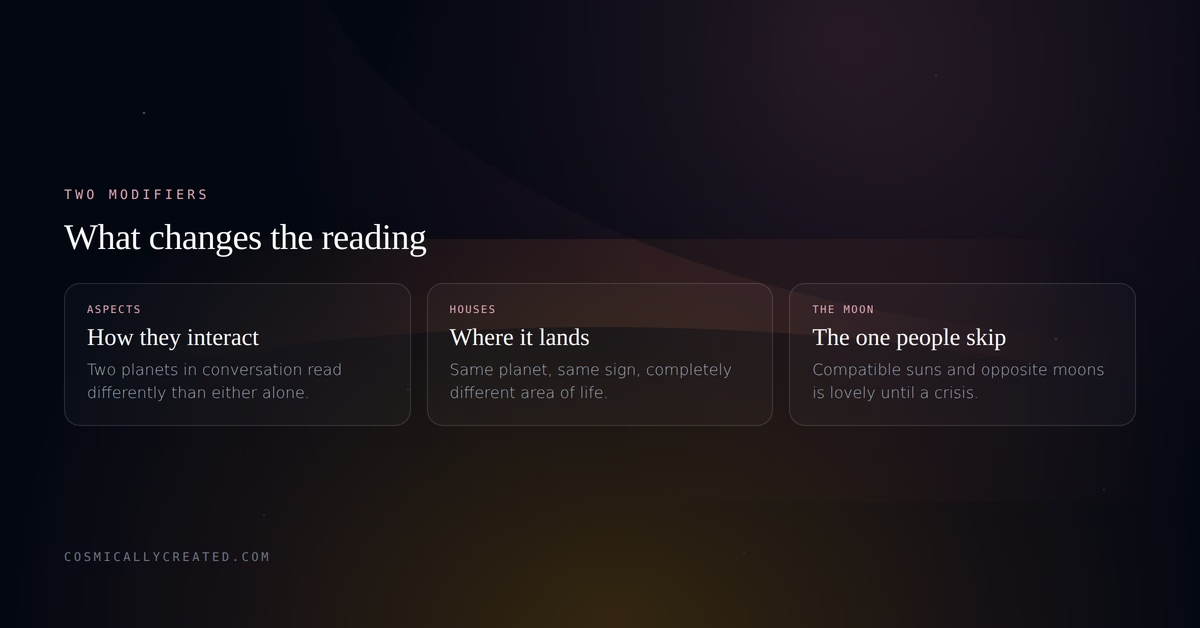
Planets are not read in isolation. The angles between them change what each one is doing, and this is the layer that explains most of the contradictions people notice in themselves.
Conjunction, same place. Two departments fused, unable to operate separately. Powerful and impossible to untangle.
Opposition, opposite sides. Two departments pulling against each other, usually experienced as a thing you swing between rather than a thing you balance.
Square, ninety degrees. Friction. The two cannot ignore each other and do not agree, and this is where most of the productive difficulty in a chart lives.
Trine, a hundred and twenty. Easy agreement. So easy it is often invisible, because a thing that has never been difficult does not register as an ability.
Sextile, sixty. Cooperation available if you go and get it. Less automatic than a trine.
The practical point is that a difficult aspect is not bad news. Squares are where people actually develop, and charts with very few of them tend to belong to people who found things easy and therefore never had to build the muscle.
Why the same planet reads completely differently in two charts
Everything above is only half the picture, because the house changes the whole reading.
Take a Capricorn moon. The department is what you need when things go wrong. The strategy is structure, competence, not needing anything visibly.
In the fourth house that plays out at home and in family, and it usually means somebody who was the steady one in a house that needed a steady one, quite young.
In the tenth it plays out in public and career, and it looks like a person whose sense of safety is tied to being good at their work, which is a different life entirely with identical astrology.
Which house each planet lands in is set by your rising sign, and your rising sign is set by your birth time. That is the whole reason the next part of this series exists.
Without a birth time you can still read every planet by sign, and you have most of what the planets mean available to you. What you lose is where any of it happens.
Chiron, the nodes, and everything else in the list
Most chart software hands you more than ten symbols, and the extras cause a lot of unnecessary anxiety, so here is what they are.
The north and south nodes
Not objects at all. They are the two points where the moon’s orbit crosses the sun’s apparent path, which is why eclipses only happen near them. They are read as a pair, one describing what is already familiar and one describing what is not, and they sit exactly opposite each other by definition.
Chiron
A small body between Saturn and Uranus, and a relatively recent addition, discovered in 1977. It is usually read as the place where something went wrong early and where you subsequently became unusually useful to other people. Take it seriously or leave it out. Plenty of good astrologers do each.
The asteroids and the rest
Ceres, Pallas, Juno, Vesta, Lilith, various points with names. All optional. None of them will change a reading you have not already got from the ten main bodies, and a chart with forty symbols on it is not a more accurate chart, it is a harder one to read.
My honest advice is to ignore every one of these until the personal five feel obvious to you. Adding resolution to a picture you cannot yet see does not make it clearer, it just makes it busier, and this is the stage where most people give up on charts entirely.
Retrograde planets, and what they actually do
If something in your chart is marked with a small R, that planet was moving backwards from earth’s point of view on the day you were born.
It is an apparent motion rather than a real one. The planet does not reverse. We overtake it, or it overtakes us, and for a stretch of weeks it appears to slide backwards against the fixed stars, the same way a slower car appears to move backwards when you pass it.
In a birth chart it does not mean the department is broken. It means it runs inward before it runs outward.
A retrograde Mercury tends to belong to somebody who thinks it through completely before saying any of it, and is then baffled that everyone else appears to be talking without having finished. A retrograde Venus often means the standard for what is worth having was worked out privately and does not match the room.
Roughly one person in five has Mercury retrograde natally, and about forty percent of people have Saturn retrograde, so this is not a rare affliction. It is common enough to be a normal variation.
The one thing worth separating is a natal retrograde from a transiting one. A natal retrograde is a permanent feature of how a department runs. The Mercury retrograde everyone complains about three times a year is a temporary condition affecting everybody at once, and the two get confused constantly.
The houses in one pass, so you know where things land
Every planet above lands in one of twelve rooms. Here they are in a sentence each, so you can place anything you find.
- First, you. Appearance, approach, the thing people meet before they know anything.
- Second, what you have. Money, possessions, and your own sense of worth.
- Third, the near world. Siblings, neighbours, short journeys, everyday communication.
- Fourth, home and origin. Family, the private base, where you came from.
- Fifth, what you make. Creativity, play, romance, children.
- Sixth, the daily grind. Work, routine, health, service.
- Seventh, the other person. Partnership, close contracts, open enemies.
- Eighth, what is shared and hidden. Deep exchange, other people’s resources, endings.
- Ninth, belief. Meaning, study, long journeys, the framework you live by.
- Tenth, the public one. Career, reputation, what you are known for.
- Eleventh, the wider group. Friends, networks, the future you are aiming at.
- Twelfth, the unseen. Rest, retreat, the part of you that does not go out in public.
In whole sign houses each of those is exactly one sign, which means each is also a stretch of weeks in the calendar year. That is the connection the rest of this site is built on, and it is why an empty house is worth knowing about rather than worrying about.
The planet is the department. The sign is the strategy. The house is where it happens.
How to read your own without drowning
Pull your chart, then do this in order and stop when you have had enough.
Read the moon first
Its sign, then its house. Ask whether the description matches what you actually need on a bad day rather than what you wish you needed.
Then Mercury and Venus
These two are usually near your sun and they explain the parts of you that do not match your sun sign description. Most of the “I am not like my sign” feeling lives here.
Then Mars, then Saturn
Mars for how you act and argue. Saturn for the thing you had to learn the hard way and are now quietly good at.
Leave the outer three until last
They are generational. Read the house they sit in rather than the sign, because the house is the part that is yours.
Four placements read properly will tell you more than ten skimmed, and that is the honest answer to what the planets mean in practice.
Questions about what the planets mean
What do the planets mean in astrology?
Each one describes a different department. Sun for visibility, moon for safety, Mercury for communication, Venus for value, Mars for action. The outer ones describe a generation more than a person.
Which planet is the most important in a birth chart?
The one people should read first is the moon, not the sun. The moon describes what somebody needs when things go wrong, which decides most of how a life feels from inside.
What are aspects?
The angular relationships between planets. Two planets in conversation read differently than either would alone, and aspects are where the ease and the friction in a chart actually live.
What do the houses do?
They describe where something plays out. The same planet in the same sign lands in a completely different area of life depending on which house it falls in, which is set by your birth time.
Why is my Venus not in my sun sign?
Venus never travels far from the sun, so it is usually in your sun sign or one of the signs either side. That is astronomy rather than interpretation.
Do I need to know all of this to read my chart?
No. Read the sun, the moon and the rising first and you will have most of the useful picture. The rest adds resolution.
Season boundaries move by a day some years, because the equinoxes and solstices drift against the calendar.
See it in your own chart
The Season Map is free, six pages, no birth time required. It lays out all twelve seasons in the order the year runs and shows you how much of your own chart each stretch actually touches.
If you want the full read written for your chart specifically, that is The Seasonal Blueprint.
Keep reading
Want your own year mapped out like this?
A Season Map is six pages built from your birth chart. It lays your year out as a calendar: the weeks that are loaded, the months that hold nothing at all, with real dates. It costs nothing and I write them by hand.
You are on the list.
Your Season Map is being written by hand, so give it a few days. It lands from Jakayla at cosmicallycreated.com, so keep an eye out for that name.