
Capricorn sun, ten things people get wrong about you
The Capricorn sun misunderstood traits are all the same misread. Cold, ruthless, workaholic, controlling and joyless are descriptions of somebody running on structure in the one month of the year that offers nothing back, judged by people whose season hands them constant feedback.
If you have a Capricorn sun, born roughly 22 December through 19 January, you have been called cold, ruthless, workaholic, emotionally unavailable, controlling, pessimistic and status obsessed often enough that people treat your whole personality as one long joyless climb.
They talk about you like a machine that learned to wear a suit. Like the discipline is a personality defect rather than a method, and the reserve is an absence of feeling rather than a decision about where feeling goes.
Here is what they are missing. Your sun sign is not a refusal to enjoy anything. It maps onto a very specific stretch of the year, and that stretch has a problem to solve that no other month has.

Where the Capricorn sun misunderstood traits actually come from
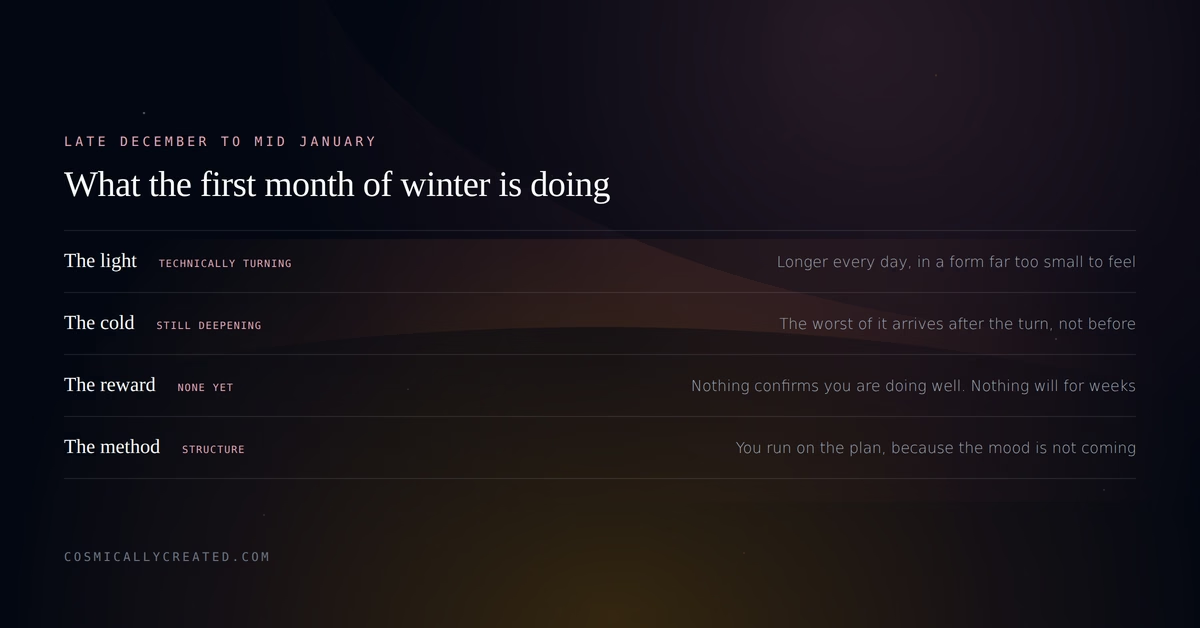
The solstice is the turning point for light. From 22 December the days get longer. But the coldest part of winter is not December, it is January into February, weeks after the light has already started coming back.
The reason is that the ground and the sea hold temperature long after the light changes. The land has been losing more heat than it gains for months and it keeps losing it for a while even once the balance tips. So the cold deepens while the light is technically improving.
Sit with what that means as a lived experience. The good news arrives first, in a form far too small to feel, and then conditions get worse for another six weeks anyway.
That is the month a Capricorn sun is built for. No feedback, no felt reward, and no external confirmation that continuing is the right call. Motivation is simply not available, so something else has to do the work.
What does the work is structure. A plan, a routine, a standard that does not require you to be in the mood. Every one of the Capricorn sun misunderstood traits on the list below is a version of that, read badly by somebody who has never had to run on it.
One honest note before the list. I am not claiming the season you were born in produced your temperament. I do not know that and neither does anybody selling it to you with confidence. What I can say is that these descriptions have tracked something for a very long time, and the seasonal parallel is the most coherent account I have found of why they track. Evidence for the language, not a mechanism underneath it.
1. They think you are cold, and you are conserving emotional energy for a long stretch
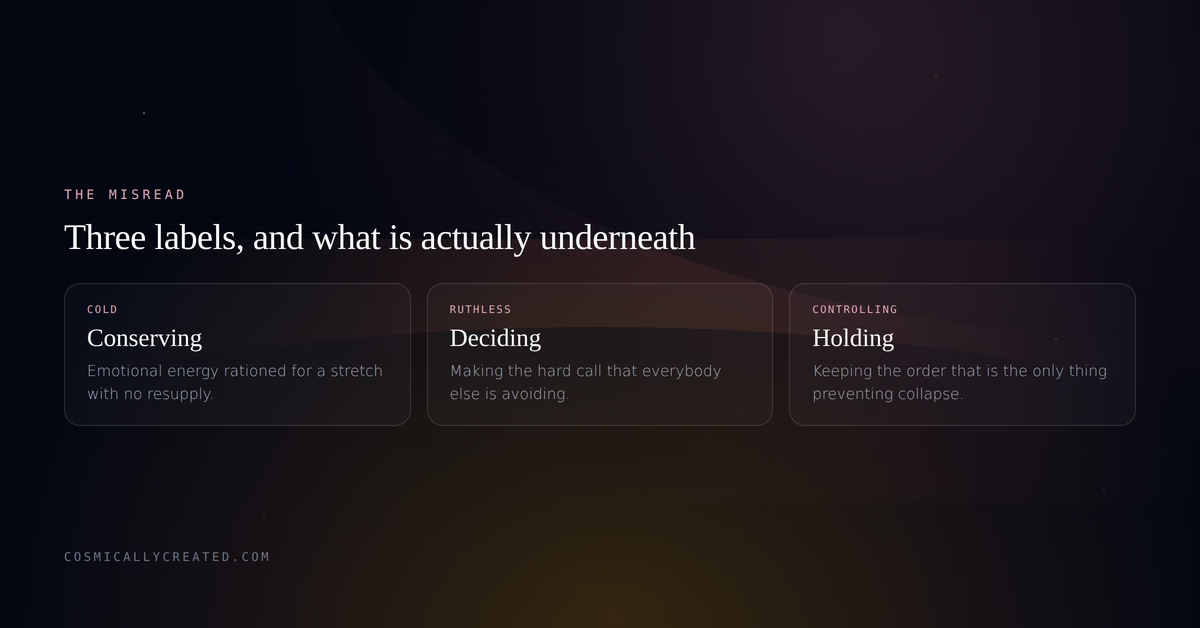
Cold implies there is nothing there. There is plenty there. It is being rationed, which is a different thing entirely and much easier to mistake for absence.
Early winter is the part of the year with no resupply. Whatever you have has to last, and spending it all in the first week is how you end up with nothing in February. So the instinct is to hold most of it back and release it where it will actually do something.
What that produces is a person who is deeply attached to a small number of people and fairly economical with everybody else. Not because the everybody else does not matter, but because the budget is finite and you have already allocated it.
The people who call you cold are usually comparing you to somebody who spends warmth freely on everyone they meet. That works fine in a month with abundance. It does not work in yours.
2. They think you are ruthless, and you are making the hard decisions nobody else will face
Ruthless suggests you enjoy the cutting. You almost never do. What you have is a tolerance for making a decision that somebody has to make and that everybody else is quietly hoping will resolve itself.
It will not resolve itself. That is the thing you understood earlier than they did. A problem that is being avoided is still a problem and it gets more expensive every week it stays unaddressed.
So you name it, you decide, and you take the consequence of having decided. The people in the room are relieved that it got handled and uncomfortable that you were the one who handled it, and those two feelings arrive together and get expressed as a judgement about your character.
The people who call you ruthless are usually people who benefited from the decision and would rather not have made it themselves.
3. They think you are a workaholic, and you are building something meant to outlast you
Workaholic frames the work as a compulsion. Sometimes it is, and I will come back to that in the shadow, but the underlying drive is not addiction to labour. It is an unusual interest in whether the thing still stands in twenty years.
Early winter is when you find out whether what you built holds. Nothing is growing, nothing is being added, and the only question that matters is whether the structure carries the load. That question is the one you are always asking.
It makes you a bad fit for anything disposable. You struggle to care about work that will be irrelevant in a quarter, and you will overinvest wildly in something with a long horizon, which reads to everyone else as an inability to switch off.
The people who call you a workaholic usually measure work by hours rather than by what survives it.
4. They think you are emotionally unavailable, and you are protecting intimacy until trust is proven
Unavailable suggests the door is locked and there is nothing behind it. The door is locked. There is a great deal behind it.
What you run is a staged release. People get more of you as they demonstrate they can be trusted with what they already have, and the stages are real and you are keeping score even when you would rather not be. That is not manipulation. It is the only risk model you have.
The cost is that it looks identical, from outside, to not having feelings. Somebody who has been given stage one has no way of knowing that stage seven exists, so they conclude the whole building is one room.
The people who call you emotionally unavailable are usually people who wanted the whole house on day one and read the pace as a verdict on them.
5. They think you are controlling, and you are maintaining the order that prevents collapse
Controlling implies you want power over people. Mostly you want the situation to hold, and you have noticed that it will not hold on its own.
You have usually been in a position, at some point and often young, where the structure genuinely was the only thing between everybody and a bad outcome, and you were the one holding it. Once you have done that you do not fully put it down again.
So you keep the systems, the plans, the contingencies and the standards, and you get tense when somebody removes one casually, because you can see the load it was carrying and they cannot.
The people who call you controlling are usually standing on a floor you built and do not know is there.
6. They think you are pessimistic, and you are realistic about risk so you can prepare for it
Pessimistic suggests you expect the worst and enjoy being right about it. What you actually do is cost the worst case, because a cost that is known can be planned for and a cost that is denied cannot.
That is a January skill. The month does not reward optimism, it rewards having enough set aside. So you run the numbers on the bad outcome first, and having run them you are usually the calmest person in the room when it happens.
The gap is that everybody hears the costing out loud and mistakes it for a forecast. You said what could go wrong. They heard that you think it will.
The people who call you pessimistic are frequently the same people who come to you first when something does go wrong.
7. They think you are status obsessed, and you are building the authority that buys autonomy
Status obsessed suggests you want to be admired. Some of that is real and I am not going to pretend otherwise. But the thing underneath it is much more practical, and it is about not being told what to do.
Position, in your reading, is not a trophy. It is leverage. It is the difference between having to explain yourself to somebody who has less information than you and simply being able to decide. You are climbing toward the point where nobody can overrule you badly.
That is why you can be completely unbothered by attention and extremely bothered by being outranked by somebody incompetent. It was never really about the applause.
The people who call you status obsessed usually have not noticed how much of what you do is aimed at buying your own freedom.
8. They think you are joyless, and you find satisfaction in a different place than they do
Joyless is the one that stings, because it is not that you cannot feel pleasure. It is that yours arrives on a delay and in a form other people do not recognise as pleasure.
Most enjoyment is immediate. A good meal, a good night, a good film. Yours tends to be retrospective. It is the thing that took four years and now works. It is looking at something finished and knowing exactly what it cost. That is a real feeling and it is not smaller than the immediate kind, it is just quieter and slower and much harder to invite somebody into.
The problem is that the immediate kind is what everybody else calls fun, so a person built for the slow kind reads as a person built for nothing.
The people who call you joyless have usually never watched you look at something you finished.
9. They think you are unforgiving, and you are declining to be harmed the same way twice
Unforgiving implies you are holding a grudge for pleasure. You are usually holding a file.
What you did was update your model. Somebody showed you how they behave under pressure, you believed them, and you adjusted your exposure accordingly. That is not vengeance, it is a revised risk assessment, and it feels the same from the other side which is why it gets called the harder word.
You will often be perfectly warm to the person afterwards. You simply will not put anything load bearing on them again. People find that colder than open hostility, because open hostility at least implies you are still engaged.
The people who call you unforgiving are usually asking for the access back rather than for the forgiveness, and those are different requests.
10. They think you are afraid of vulnerability, and you are strategic about where it happens
Afraid is the wrong word and it is worth separating from the true thing next to it.
You are not frightened of being known. You are extremely deliberate about the conditions. Vulnerability with the wrong person, at the wrong moment, in a situation you cannot control, is not courage in your reading. It is spending something valuable in a place where it will not be handled well.
So you wait, and you choose, and when it does happen it is usually startling in its completeness, because it was never that you had nothing to say.
Where this becomes a genuine problem, and this is the honest part, is that the standard for the right conditions can rise faster than anybody can meet it. At some point the caution stops being strategy and starts being the reason it never happens. That is the one on this list I would actually watch.
The bottom line on Capricorn sun misunderstood traits
If you have a Capricorn sun, you are not cold or ruthless or joyless. You are built for the stretch of the year that gives nothing back, and every trait on that list is a version of the same competence: continuing without confirmation.
That is a rarer thing than it sounds. Most people need the feedback. They need to see progress, feel momentum, get told they are doing well. You can go a very long time on none of that, and the reason the rest of us can rely on you is precisely the thing we call you cold for.
The people who get you understand that the reserve is not absence, it is allocation. The discipline is not compulsion, it is method. The pessimism is not gloom, it is preparation. And the slowness with intimacy is not fear, it is a decision about where something valuable gets spent.
The Capricorn sun traits people complain about are the ones they lean on hardest when something goes wrong. The people who do not get you will keep telling you to relax, open up, and stop taking everything so seriously. Let them. Somebody has to be holding the structure in January, and it has never once been them.
The good news arrives first, in a form too small to feel, and then it gets colder anyway.
Questions about the Capricorn sun
What are the most misunderstood Capricorn sun traits?
Cold, ruthless, workaholic, controlling and joyless. All five describe somebody running on structure through the one stretch of the year that offers no reward for continuing, read by people who have not had to.
Are Capricorn suns actually cold?
No, the warmth is rationed rather than absent. Early winter has no resupply, so whatever you have has to last, which produces deep attachment to a few people and economy with everybody else.
Why do Capricorn suns work so much?
Because the underlying interest is in whether the thing still stands in twenty years. That makes disposable work almost impossible to care about and long horizon work easy to overinvest in.
When is Capricorn season?
Capricorn season runs 22 December to 19 January, opening at the winter solstice. The dates move by a day some years.
Does the season I was born in cause my personality?
I would not claim that, and I hold the question open on purpose. The seasonal parallel explains why the description is coherent. It is evidence for the language rather than a demonstration of a mechanism.
What does a Capricorn sun actually need?
Permission to stop that comes from outside. This sign will not grant it internally, because internally the standard is the only thing holding the whole arrangement up.
Why does my Capricorn sun not feel ambitious?
Because the sun is what you are practising rather than what you already are. Your moon and rising shape how it shows up, and the ambition often points at security or autonomy rather than at a career.
What is the Capricorn shadow?
A structure that outlives the stretch it was built for. The discipline that got you through does not switch itself off, so people carry January into a year that no longer needs it and cannot work out why nothing feels good.
Season boundaries move by a day some years, because the equinoxes and solstices drift against the calendar. If your birthday sits on 21 or 22 December, pull the chart for your birth year rather than trusting a date range.
See it in your own chart
Your sun is one of twelve stretches of the year, and only one line of a chart with dozens. Your rising sign is what people meet first and your moon is what you need when things go badly, which is why two Capricorn suns can look nothing alike.
The Season Map is free, six pages, and needs no birth time. It shows which weeks of your own year are loaded and which are quiet. If you want the full read written for your chart, that is The Seasonal Blueprint.
Keep reading
Want your own year mapped out like this?
A Season Map is six pages built from your birth chart. It lays your year out as a calendar: the weeks that are loaded, the months that hold nothing at all, with real dates. It costs nothing and I write them by hand.
You are on the list.
Your Season Map is being written by hand, so give it a few days. It lands from Jakayla at cosmicallycreated.com, so keep an eye out for that name.