
Sagittarius sun, ten things people get wrong about you
The Sagittarius sun misunderstood traits are all the same misread. Commitment phobic, tactless, reckless, irresponsible and unreliable are descriptions of somebody running a strategy built for the last stretch before the solstice, judged by people who have never had to run it.
If you have a Sagittarius sun, born 22 November through 21 December, you have been called commitment phobic, tactless, reckless, irresponsible and unreliable often enough that people treat your whole personality as one long avoidance of anything serious.
They act like your need for freedom is immaturity, your honesty is cruelty and your optimism is delusion. They think you are running from something instead of running toward something.
Here is what they are missing. Your sun sign is not a refusal to grow up. It is a developmental assignment, and it maps onto a very specific stretch of the year. Sagittarius season runs through late autumn into the approach to the winter solstice, the darkest day. The days are shortening, the cold is setting in, and what gets you through is vision.
Prefer to listen? Here is the audio version of this post.
Where the Sagittarius sun misunderstood traits actually come from
This is not about being flaky or irresponsible. It is about a stretch of the year that asks for expansion, meaning making, philosophical perspective and the specific kind of intelligence that comes from being able to see past your immediate circumstances.
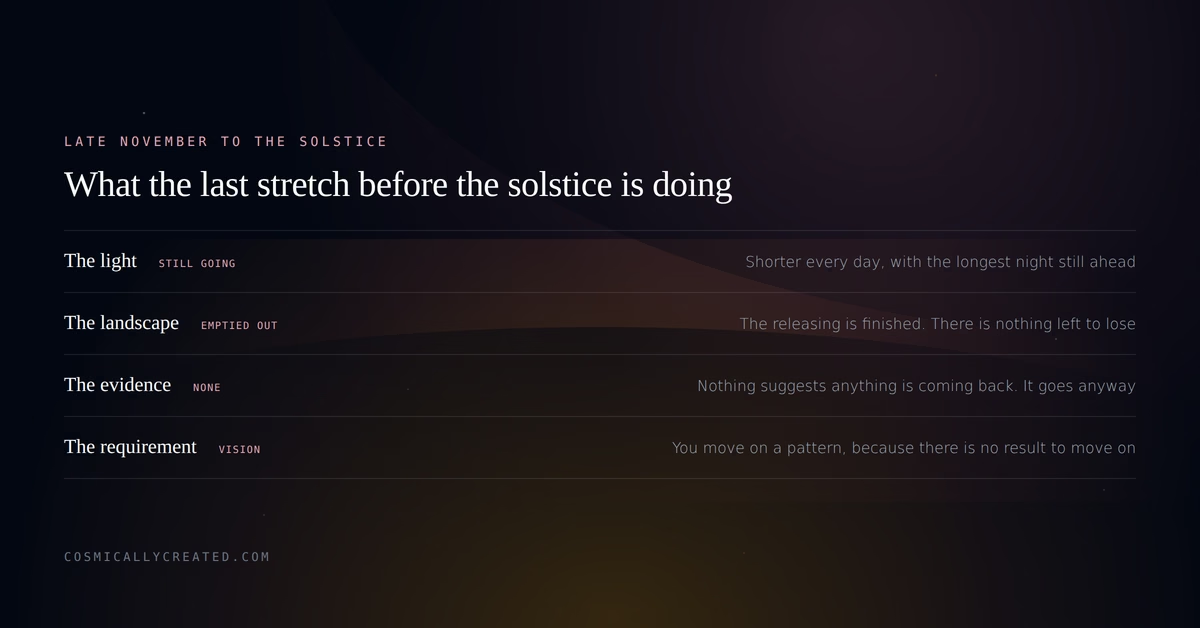
What gets labelled a Sagittarius trait is a pre solstice survival strategy. By late November the releasing is finished. There is nothing left to come apart, nothing is growing, and there is no evidence at all that anything is coming back. The light keeps shortening for another month.
That is a specific and underrated kind of difficulty. Acute loss at least gives you something to respond to. This is the flat stretch afterwards, where the crisis is over, the recovery has not started, and nothing in the landscape suggests it will.
Fire in that month is not decoration. It is the only thing available.
One honest note before the list. I am not claiming the season you were born in produced your temperament. I do not know that and neither does anybody selling it to you with confidence. What I can say is that these descriptions have tracked something for a very long time, and the seasonal parallel is the most coherent account I have found of why they track. Evidence for the language, not a mechanism underneath it.
1. They think you are commitment phobic, and you are refusing commitments that limit growth
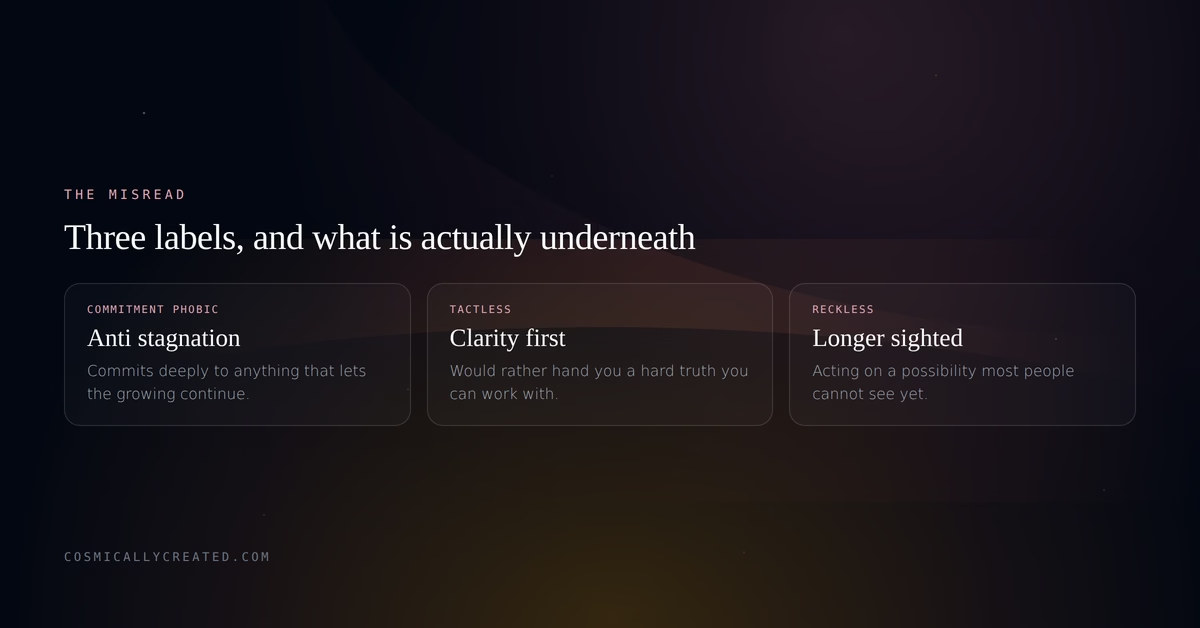
The commitment phobic label is the big one, and it completely misses what you are doing. You are not afraid of commitment. You are afraid of stagnation. Late autumn before the solstice is about maintaining movement and expansion even as everything else contracts. You need to keep growing, learning and expanding, or you feel like you are dying.
You do not avoid commitment. You avoid commitments that would cage you. You will commit deeply to things that allow continued growth, relationships that evolve, careers that expand, places that offer new experience. What you cannot do is commit to a situation that demands you stay exactly the same forever. That is not fear. That is knowing yourself.
Of all the Sagittarius sun misunderstood traits, this is the one that costs the most, because the people who use it usually want you to commit to things that would require you to stop growing. They want you to settle into fixed patterns and stay there. What they call commitment phobic is you protecting your need to keep evolving.
2. They think you are tactless, and you are prioritising truth over comfort
Tactless suggests you are socially incompetent, and you are not. You understand social convention fine. You just do not think it is more important than honesty. Late autumn before the solstice is when you need clear vision. You cannot afford comforting lies when you are heading into the darkest stretch of the year.
When you say something blunt, you are not trying to hurt anyone. You are trying to name what is real. You see through pretence quickly and you have no patience for continuing the performance. You would rather hand somebody an uncomfortable truth they can work with than a comfortable lie that keeps everybody stuck.
The people who call you tactless usually prefer polite fiction to honest feedback. They want you to soften and hedge and cushion every truth until it means nothing. What they call tactless is you offering the direct version that most people are too nervous to say.
3. They think you are reckless, and you are taking calculated risks on a longer view
Reckless implies you are not thinking about consequences. You are. You are just willing to accept certain risks in service of expansion. The stretch before the solstice rewards bold moves, because playing it safe does not get you what you need when the dark actually arrives.
When you leap into something that looks mad from outside, you are not being careless. You are betting on a possibility you can see and they cannot. You have vision. You can see pathways that are invisible to people focused only on immediate circumstances. You do take risks. They are based on seeing further ahead.
The people who call you reckless usually cannot see past next week. They think planning means controlling every variable. You know that real planning means staying adaptable and moving fast when the opportunity appears. What they call reckless is you acting on a longer range view than most people can access.
4. They think you are irresponsible, and you are prioritising experience over obligation
Irresponsible suggests you are neglecting duties. You are not neglecting them, you are questioning whether they are actually duties or just habitual obligations that serve nobody. This stretch of the year is about conserving energy for what matters, and you cannot spend it on things that do not.
You are responsible to what you value, which is growth and truth and experience and learning. You are simply not responsible to obligations that other people assigned you without your agreement. When you skip something important, it is usually because you have evaluated it and decided it is not actually important. That is priorities rather than negligence.
The people who call you irresponsible usually confuse responsibility with obedience. They think being responsible means doing what you are told. You think it means doing what matters. Those are not the same thing.
5. They think you are superficial, and you are sampling widely to find the pattern
The superficiality accusation shows up because you try many things, learn a bit of everything, and refuse to become an expert in one narrow area. You are not superficial. You are synthesising. The pre solstice stretch requires broad perspective, because you need the whole picture rather than one detailed corner of it.
You sample widely because you are looking for patterns and connections across different domains. You are not interested in going deep into one thing if it means missing the relationships between things. You are a synthesiser rather than a specialist, and you want to understand how it all fits together.
The people who call you superficial usually value depth over breadth and think specialisation is automatically superior. They cannot see the intelligence in synthesis. You are not skimming out of laziness. You are covering ground because you are mapping territory.
6. They think you are unreliable, and you are refusing to lock into plans that have expired
Unreliable suggests you do not follow through. You do follow through on what matters to you. What you will not do is honour a commitment to a plan that is no longer relevant. This part of the year is dynamic. Conditions change, better options appear, and you have to stay adaptable or you miss them.
When you change plans you are not being flaky, you are responding to new information. You made the plan based on what you knew then. Now you know more, so you are adjusting. That is intelligence. The friction is that other people want plans to be fixed and you see them as provisional frameworks that evolve.
The people who call you unreliable usually need rigid plans in order to feel secure. You cannot live that way, because you need the flexibility to respond to an opportunity. What they call unreliable is you staying open to something better.
7. They think you are overpromising, and you are speaking from vision rather than current fact
The overpromising accusation comes up because you talk about possibilities as though they were certainties, and sometimes they do not arrive. You are not lying, you are speaking from vision. This stretch requires optimism, because if you cannot see beyond current limitations you will not make it through what is coming.
When you say something will happen, you mean it could happen if the conditions align and everybody commits. You are not guaranteeing an outcome, you are painting a picture of a possibility. Other people hear a promise where you meant a vision, and that is a translation problem rather than dishonesty.
The people who call you overpromising usually want guarantees you cannot give. They want you to speak only about what is certain, which is almost nothing. You speak from possibility because possibility is what moves anybody to act.
8. They think you are preachy, and you are sharing the frameworks that got you through
Preachy implies you are imposing beliefs on people. You are not trying to convert anybody, you are trying to share frameworks that work for you. This is the stretch where you need meaning making systems in order to navigate the dark, so you find them, and yes, you share them enthusiastically, because they helped.
You talk about the big ideas, truth and meaning and freedom and belief, because they matter to you. You are not saying everybody should think what you think. You are saying here is how I make sense of this, maybe it will be useful. That is offering rather than imposing.
The people who call you preachy are usually uncomfortable with anybody holding strong philosophical convictions out loud. They think beliefs should be private and quiet. You cannot do that, because your beliefs inform how you live and you process by discussing.
9. They think you are restless, and you need variety in order to stay engaged
Restless suggests you cannot sit still, which is not quite right. You can be still. You just cannot be still in the same place doing the same thing forever. This part of the year is about gathering diverse experience before everything locks down, so you need variety and new terrain or you stagnate.
You move often, physically and intellectually and emotionally, because sameness kills your vitality. You are not running from anything. You are running toward novelty, which is the thing that keeps you engaged with being alive. When something becomes routine you lose energy. When it is new, you are back.
The people who call you restless usually find comfort in repetition. They think stability means sameness. You find stability in movement, and you need change in order to feel grounded.
10. They think you are noncommittal about beliefs, and you are holding them provisionally while you learn
This one is related to the first and it is worth separating. People think you have no real beliefs because you change your mind when you get new information. You do have beliefs. You just hold them as your best current understanding rather than as absolute truth, because this stretch of the year is about staying open to what you have not learned yet.
You are philosophically curious, which means you are always learning, which means your understanding keeps moving. You believed something yesterday based on what you knew yesterday. You believe something else today based on what you know today. That is growth rather than inconsistency.
The people who think you are noncommittal usually believe that real conviction means never changing your mind, and that doubt is weakness. You think flexibility is strength. You are committed to finding out what is true, which sometimes means letting go of a belief that no longer holds up.
The bottom line on Sagittarius sun misunderstood traits
If you have a Sagittarius sun, you are not flaky or tactless or irresponsible. You are a pre solstice specialist, built for expansion, vision, meaning making and the kind of intelligence that comes from seeing past immediate circumstances to what might be possible.
You are not here to settle into a fixed pattern and stay in it. You are here to keep growing and expanding what you understand. You are not here to soften the truth to protect somebody’s feelings. You are here to name what is real so that everybody can work with it. You are not here to honour obligations that do not serve growth. You are here to protect your freedom to evolve.
The people who get you understand that the love of freedom is not fear, it is a need for growth. The bluntness is not cruelty, it is clarity. The optimism is not delusion, it is vision. The adaptability is not flakiness, it is intelligence.
The people who do not get you will keep asking you to settle down, commit, be more careful and think before you speak. Let them. You have more important work, which is holding the vision that carries other people through the dark stretches when they cannot see the way forward themselves.
You are not running from anything. You are running toward something.
Questions about the Sagittarius sun
What are the most misunderstood Sagittarius sun traits?
Commitment phobic, tactless, reckless, irresponsible and unreliable. All five are descriptions of somebody running a strategy built for the last stretch before the solstice, being read by people who have not had to run it.
Is a Sagittarius sun actually commitment phobic?
No. The aversion is to stagnation rather than to commitment. A Sagittarius sun will commit deeply to anything that lets the growing continue, and cannot commit to something that requires staying exactly the same.
Why are Sagittarius suns so blunt?
Because clarity matters more to them than comfort. The bluntness is not carelessness about your feelings, it is a preference for a hard truth you can act on over a soft one that leaves you stuck.
When is Sagittarius season?
22 November to 21 December, the last stretch of autumn running into the winter solstice. The dates move by a day some years.
Does the season I was born in cause my personality?
I would not claim that, and I hold the question open on purpose. The seasonal parallel explains why the description is coherent. It is evidence for the language rather than a demonstration of a mechanism.
What does a Sagittarius sun actually need?
To be taken seriously. The lightness is a working method rather than an absence of depth, and being treated as the fun one is a specific kind of loneliness.
Why does my Sagittarius sun not feel adventurous?
Because the sun is what you are practising rather than what you already are. Your moon and rising also shape how any of it shows up, and a heavily earth or water chart will run this sun much more quietly.
Are Sagittarius suns unreliable?
They follow through on what matters to them. What they will not do is honour a plan that has expired, which reads as unreliability to anybody who needs plans to be fixed.
Season boundaries move by a day some years, because the equinoxes and solstices drift against the calendar. If your birthday sits on 21 or 22 November or December, pull the chart for your birth year rather than trusting a date range.
See it in your own chart
Every one of the Sagittarius sun misunderstood traits above describes your sun, and your sun is one of twelve stretches of the year, and only one line of a chart with dozens. Your rising sign is what people meet first and your moon is what you need when things go badly, which is why two Sagittarius suns can look nothing alike.
The Season Map is free, six pages, and needs no birth time. It shows which weeks of your own year are loaded and which are quiet. If you want the full read written for your chart, that is The Seasonal Blueprint.
Keep reading
Want your own year mapped out like this?
A Season Map is six pages built from your birth chart. It lays your year out as a calendar: the weeks that are loaded, the months that hold nothing at all, with real dates. It costs nothing and I write them by hand.
You are on the list.
Your Season Map is being written by hand, so give it a few days. It lands from Jakayla at cosmicallycreated.com, so keep an eye out for that name.