
Virgo, from perfectionism to purpose
Virgo energy is what the end of summer does. Everything that grew is finished growing, none of it keeps forever, and something has to decide what is worth carrying into the dark. That is discernment. It gets called criticism by people who have never had to make the call.
I am going to be upfront about my bias here. I have Virgo rising, so I have spent my whole life being the person who notices the thing nobody wanted noticed, and then being told I am being difficult about it. This one is personal.
Here is what I want to do with this post. Not defend Virgo, because Virgo does not need defending, and not hand you a list of traits you could get anywhere. I want to show you the conditions the sign describes, because once you see those, every single thing people complain about Virgo stops looking like a personality defect and starts looking like a job description.
So let me start where I always start, which is not with the sign. It is with what late August is actually doing.
Where Virgo energy comes from
Picture the last week of August. The light has already started going. Not dramatically, not enough that most people consciously clock it, but the evenings are shorter than they were in July and something in you knows it.
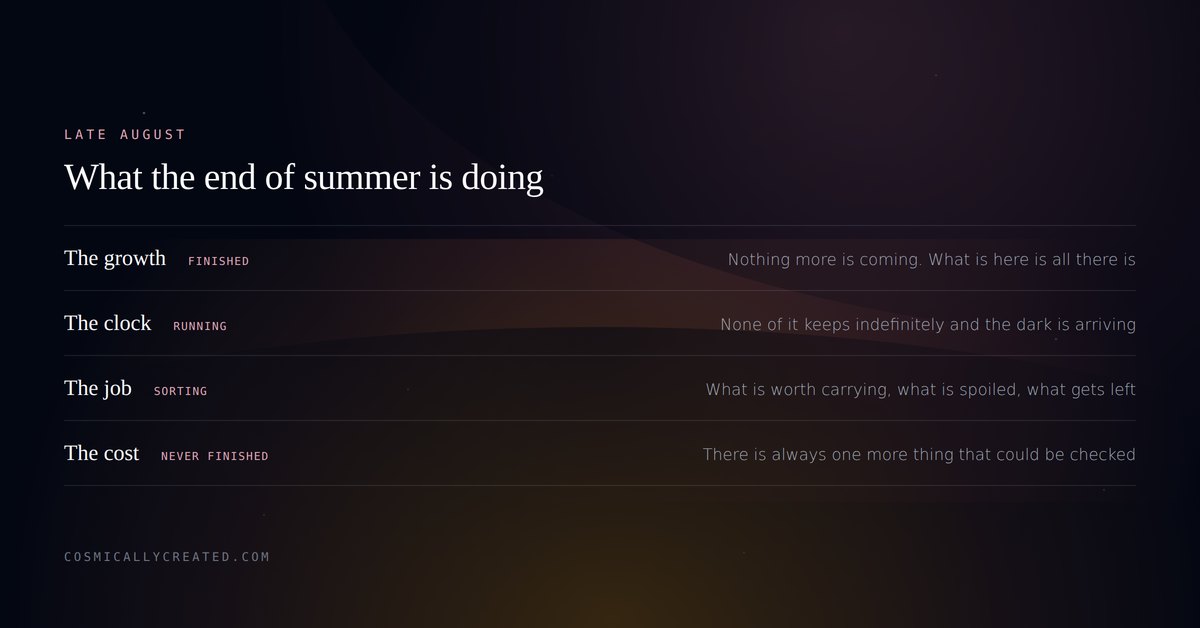
Everything that was going to grow this year has grown. That is the part people miss. Late August is not the middle of anything. It is the end of the growing stretch, the point where the output stops increasing and the total is whatever it is.
And here is the condition that makes Virgo make sense. Not all of it keeps.
Some of what came up is genuinely good and will last. Some of it is already turning and will spoil whatever it touches. Some of it takes far more effort to preserve than it will ever give back. And you cannot carry everything, because there is a finite amount of energy and a finite amount of space and a very real deadline in the form of a winter that is definitely coming.
So the strategy that survives that month is not enthusiasm. Enthusiasm was July’s job and July did it beautifully. The strategy that survives late August is discernment. Sort. Assess. Keep what earns keeping. Deal with the spoiled thing before it spreads. Be honest about what is actually worth the resources.
That is Virgo energy. The whole sign is one month of the year where the useful skill is telling the difference between what is worth carrying and what is not.
It is unglamorous, it makes nobody feel good in the moment, and every single person benefits from somebody doing it.
Virgo energy is discernment, not perfectionism
This is the confusion at the centre of every Virgo conversation and I want to take it apart properly, because the two look identical from outside and are completely different from inside.
Discernment is deciding what deserves your resources. It is finite. You look at the thing, you make the call, you move to the next thing. It ends.
Perfectionism is the belief that the call is never safe to make, because you might have missed something, and if you missed something it is your fault. It does not end. There is always one more thing that could be checked.
Same behaviour, same person, sometimes the same afternoon. The difference is whether it stops. Virgo energy is built for the version that stops.
Virgo energy is built for the first one. What happens to a lot of Virgos is that they get so much evidence over the years that they are the only person in the room actually looking, that noticing stops being a task and becomes a permanent state. And a permanent state of noticing what is wrong is exhausting in a way that is genuinely hard to explain to somebody who has never lived in it.
If you are a Virgo reading this and something in your chest just went tight, that is what I am pointing at. You are not a perfectionist by nature. You are somebody with a sorting instinct who never gets told the sorting is finished.
Why this pattern got a name at all
I want to be careful here, because this is the part where astrology content usually overclaims and I would rather not.
The zodiac is a symbolic system built from watching the solar cycle. People lived inside the same year happening over and over, noticed that different stretches of it had a distinct character, and built language for it. Late August has a specific quality of light and a specific set of conditions, and it has had them for a very long time, and eventually somebody gave that stretch a name and a description.
What I am not going to tell you is that being born in late August caused you to be discerning. I do not know that, nobody does, and the honest position is that the causal question stays open.
What I will say is that the description tracks, remarkably well, far more often than random would explain. Whether that is because the conditions of a year leave a mark, or because a very old system got extremely good at describing one twelfth of human variation and attached it to a date, I genuinely cannot tell you.
The seasonal parallel is evidence for why the description holds together. It is not proof of a mechanism. I would rather hand you an honest gap than a confident answer I invented.
Either way the description is useful, and that is the thing I actually care about.
What Virgo energy looks like in a modern life
None of us are literally sorting what will keep through a winter. So what does the same instinct look like when there is no physical version of the task?
It looks like the person who reads the contract. The one who notices the tone in the email before anybody else does. The one who has already worked out which part of the plan is going to fall over, and who has usually worked it out three weeks before it falls over.
It looks like being the person other people quietly organise themselves around without ever saying so. Virgos tend to find out how much load they were carrying only when they stop, and the reaction of everybody else is genuinely surprising to them.
It also looks like doing the version of care that leaves no trace. Virgo love is a fixed thing, a solved problem, a filled fridge, a form submitted before the deadline you did not know about. It is the least visible love language there is, and it is why so many Virgos feel like they give constantly and receive nothing back. What they are actually experiencing is a currency mismatch, which I will come back to.
The critical label, and why it is a misread
Nobody calls a smoke alarm negative, and that is most of what people get wrong about Virgo energy.
That is genuinely the whole argument, but let me spell it out, because the label sticks to Virgos harder than almost any other sign and it does real damage.
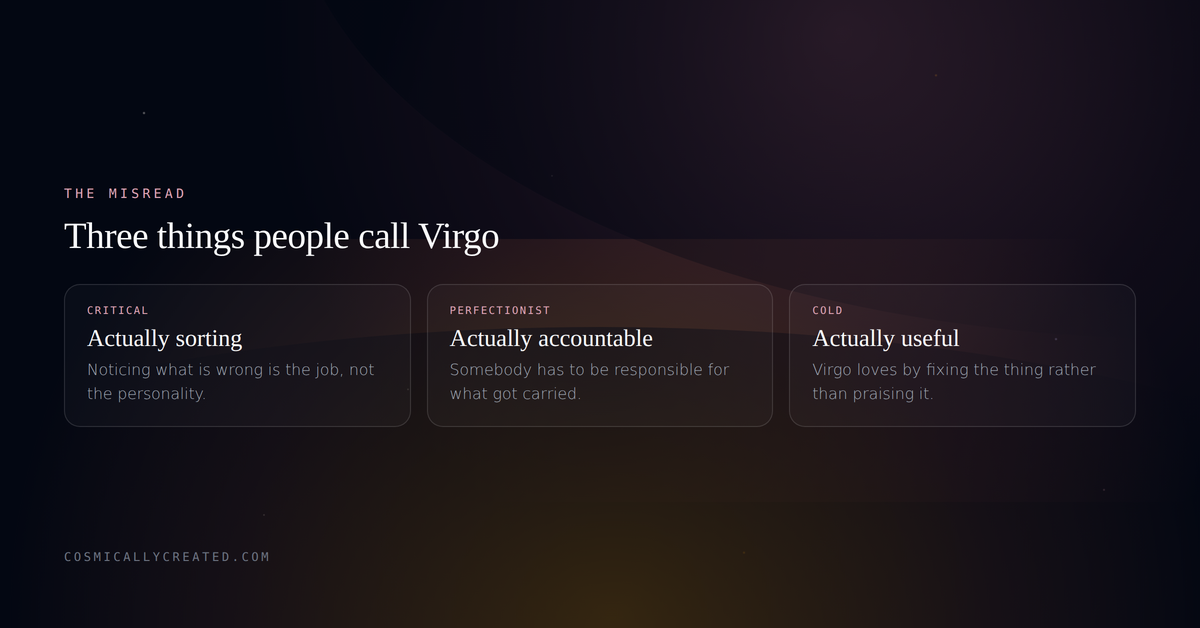
Noticing what is wrong is the function. In late August, the thing that has started to turn is the most important object in the room, because it will take everything else with it if nobody deals with it. A system that only reports good news is not being kind. It is being useless.
So when a Virgo walks into your situation and immediately identifies the weak point, that is not pessimism and it is very rarely an attack. It is the instrument doing what the instrument does.
Where it does go wrong, and I want to be fair here rather than defensive, is delivery. Virgo energy is not naturally warm about the finding. It reports the finding. And a correct finding delivered flatly, at the wrong moment, to somebody who needed encouragement rather than accuracy, lands as contempt even when there is none in it.
That is a real thing worth working on if you are a Virgo, and it is a completely different problem from being a critical person. One is a timing and framing skill you can learn. The other is a character flaw you do not actually have.
What Virgo actually needs, and will not ask for
Here is the thing I most want a Virgo to read.
You need to be told the work landed.
Not praised in general, which most Virgos find slightly unbearable, and not thanked in a vague way that could apply to anybody. Told, specifically, that the exact thing you noticed was the right thing to notice and that it mattered.
Virgos almost never ask for this, for a reason that makes sense once you see it. Asking would mean admitting the work was for recognition, and the whole self concept is built on the work being for the work. So the ask does not happen, the acknowledgement does not arrive, and a slow quiet resentment builds that the Virgo will usually describe as being tired rather than being unseen.
The second thing, and this one is harder, is permission to stop sorting. Not forever. For an evening. That requires somebody else to genuinely be holding the situation, not just saying they are, because a Virgo can tell the difference immediately and will simply keep monitoring in the background while pretending to relax.
The third is much smaller and much easier. Let them fix something for you and do not treat it as unnecessary. Turning down Virgo help is turning down the way they say they love you.
The Virgo energy shadow, when service becomes self-sacrifice
Every sign has a version of its own strength that goes wrong, and Virgo’s is specific and quite sad.
It starts as usefulness. Being the person who handles things is a real contribution and it earns real appreciation. Then somewhere along the way, usually early and usually not consciously, it stops being a thing you do and becomes the reason you think you are allowed to be there.
That is the shadow. Not perfectionism, which is the symptom everybody names, but the belief that the service is the price of admission. That if you were not fixing, sorting, noticing and carrying, there would be no reason for anybody to keep you around.
You can spot it by one test. Ask whether you can receive without immediately reaching for something to give back. If the answer is no, if being helped produces a low hum of anxiety until you have evened the ledger, that is the shadow talking.
And it compounds, because a person operating that way attracts people happy to be served, which produces more evidence that the service is why they stay, which tightens the whole thing.
The way out is not doing less. Virgos who try that just feel useless and go back. The way out is testing the belief. Do slightly less, on purpose, with people you actually trust, and watch what happens. Almost always what happens is nothing, and the nothing is the point.
Everything cannot be carried. Something has to decide, and that job is thankless by design.
How to support a Virgo without making them feel useless
This is the section people actually came for, so let me be concrete.
Name the specific thing
Not “you do so much.” That bounces straight off. Say the actual thing. “You caught the date error and it would have cost us the whole week.” Specific, factual, no adjectives required. That is the only form of appreciation Virgo energy reliably absorbs.
Take something off the list without asking
Do not offer to help, because a Virgo will say no reflexively and then do it themselves at eleven at night. Just do one thing, tell them it is done, and let them check it, because they will check it and that is fine.
Do not tell them to relax
It reads as being told that the thing they are worried about is not real. It usually is real, that is the whole problem. Ask what would need to be handled for them to be able to put it down, then handle that.
Let the fixing happen
When a Virgo reorganises your kitchen or corrects your spreadsheet or sends you the better version of the thing you already sent, that is affection. Receiving it warmly costs you nothing and it is the exchange they are actually offering.
Be accurate with them
Do not soften facts to protect a Virgo’s feelings. They will notice the softening, trust you slightly less, and go find the real number themselves. Accuracy is how you show respect to this sign.
The Virgo gift, which is practical care
Every sign teaches the rest of us something, and Virgo energy teaches the least fashionable lesson available.
That love is mostly maintenance.
We have a whole culture built around the declaration, the gesture, the moment. Virgo energy is the argument that none of that holds anything up. What holds things up is somebody noticing the small failure early and dealing with it quietly, over and over, for years, without it ever becoming a story anybody tells.
Nobody writes songs about that. It is the reason anything survives.
And there is a version of this that goes past relationships. Virgo is the part of the year that says caring about something means being willing to look at it honestly, including the parts that are not working. Enthusiasm that cannot survive an accurate assessment was never really about the thing.
That is a genuinely uncomfortable idea and I think it is correct.
So what is the Virgo journey actually about
From perfectionism to purpose, which is where the title came from, and it is the whole arc of Virgo energy in one line.
Perfectionism is sorting with no stopping condition. Everything gets checked because nothing is ever confirmed safe. It is exhausting and it is also, if you look at it honestly, a way of never having to be responsible for a judgement, because you have not finished judging yet.
Purpose is sorting with a reason. You are not checking everything. You are checking this, because this is what you decided deserves the resources, and the deciding is the actual skill.
The journey is the distance between those two, and it is not travelled by becoming more relaxed. Virgos who try to fix themselves by caring less usually end up somewhere worse. It is travelled by getting better at the call. By trusting your own assessment enough to close it. By accepting that some things will be missed and that a missed thing is not a moral failure.
The end of summer does not check everything either. It runs out of time, keeps what it can, and lets the rest go into the dark. That is not carelessness. That is the only way anything makes it to spring.
And that is Virgo.
Questions about Virgo energy
What is Virgo energy?
It is the strategy the end of summer runs on. Sort what is worth keeping, notice what is spoiled before it spreads, and carry the decision on behalf of everybody who did not want to make it.
Why is Virgo called critical?
Because noticing what is wrong is literally the function. Late August requires somebody to identify what will not survive, and doing that well looks unkind from outside. Nobody calls a smoke alarm negative.
Is Virgo a perfectionist?
The perfectionism is a symptom rather than the trait. Discernment is sorting that stops. Perfectionism is sorting that never gets a stopping condition, usually because nobody ever told the Virgo the sorting was finished.
What does Virgo energy look like day to day?
Being the person who read the contract, noticed the tone in the email, and worked out which part of the plan would fall over three weeks before it did. Usually without mentioning any of it.
What does a Virgo actually need?
To be told the specific thing landed. Not general praise, which bounces off, but the actual detail they caught and why it mattered. They will almost never ask for this.
When is Virgo season?
23 August to 22 September, the last month of summer before the equinox tips the year into autumn and Libra.
What is the Virgo shadow?
Service that turns into self-sacrifice. Not doing too much, but coming to believe the doing is the price of being allowed to stay. You can test for it by noticing whether you can receive without immediately evening the ledger.
Season boundaries move by a day some years, because the equinoxes and solstices drift against the calendar.
Where your own Virgo energy lives
Everybody has Virgo somewhere, whether or not they were born in it. It is one twelfth of your year either way, and it describes a specific stretch of weeks where sorting honestly is the thing that works and enthusiasm is not.
Knowing which weeks those are changes how you plan a year. It is also, for a lot of people, the explanation for why one particular month reliably makes them feel picky and impossible to please.
The Season Map is free, six pages, no birth time required, and it shows you which stretches of your own year are loaded and which are quiet. If you want the full read, that is The Seasonal Blueprint.
Keep reading
Want your own year mapped out like this?
A Season Map is six pages built from your birth chart. It lays your year out as a calendar: the weeks that are loaded, the months that hold nothing at all, with real dates. It costs nothing and I write them by hand.
You are on the list.
Your Season Map is being written by hand, so give it a few days. It lands from Jakayla at cosmicallycreated.com, so keep an eye out for that name.